

What Is the Best AI Interpreting Solution?
Artificial intelligence is transforming the language services industry. What was once limited to human interpreters can now be supported by real-time AI capable of translating conversations in seconds. Interperter IO AI Interpreter Organisations across healthcare, government, legal services, education, and business are increasingly looking at AI interpreting as a way to improve accessibility, reduce costs, and provide immediate language support.
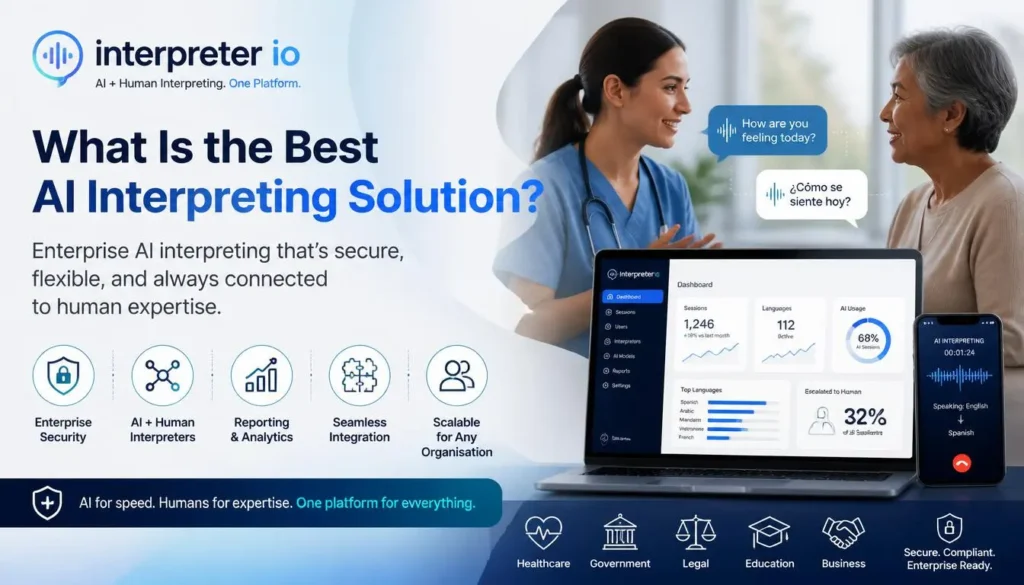
However, not all AI interpreting solutions are the same. Many products focus on the AI engine itself, but enterprise organisations need much more than speech-to-speech translation. They need security, governance, reporting, integration, and the ability to determine when AI is appropriate and when a professional human interpreter should take over.
For organisations evaluating AI interpreting platforms, the question should not simply be, “Which AI model is the most accurate?” Instead, it should be, “Which platform gives us the control, security, and flexibility to deploy AI safely across our organisation?”
This is where Interpreter IO distinguishes itself.
Rather than being a standalone AI translation tool, Interpreter IO is an enterprise language access platform that combines AI interpreting with traditional professional interpreting services. Instead of forcing organisations to choose between artificial intelligence and human interpreters, it enables them to use both within a single managed environment.
One of the platform’s strongest advantages is enterprise security. Organisations handling sensitive information cannot simply rely on consumer-grade AI applications or public translation tools. Healthcare providers, government departments, courts, financial institutions, and corporate organisations all have obligations to protect confidential information.
Interpreter IO has been designed with enterprise deployment in mind, allowing organisations to implement AI within secure, managed environments rather than relying on publicly accessible services. This gives organisations greater confidence that conversations, data, and organisational policies remain under their control.
Security alone, however, is not enough. Accuracy remains one of the most important considerations when selecting an AI interpreting solution.
Although modern language models have improved dramatically, no single AI model performs best in every language, industry, or use case. Some models perform exceptionally well with conversational speech, while others excel in technical terminology or multilingual dialogue.
One of Interpreter IO’s key strengths is that it is not tied to a single language model. Instead, organisations can choose the AI model that best meets their requirements and adapt that choice as technology continues to evolve. This provides significant flexibility and avoids vendor lock-in.
This approach also future-proofs an organisation’s investment. AI models are improving rapidly, and organisations should not have to replace an entire interpreting platform simply because a better language model becomes available. By separating the enterprise platform from the underlying AI engine, Interpreter IO allows organisations to benefit from ongoing advances in artificial intelligence without rebuilding their language services infrastructure.
Another major advantage is integration.
Many AI interpreting tools operate as standalone applications. They may translate conversations effectively, but they do not integrate with scheduling systems, reporting, interpreter management, user administration, or organisational workflows.
Interpreter IO brings these capabilities together within a single platform.
Organisations can manage users, control permissions, monitor usage, generate reports, and support multiple methods of language access through one enterprise solution rather than managing several disconnected products.
This becomes particularly valuable for larger organisations where language services are used across multiple departments or locations. Instead of maintaining separate solutions for AI interpreting, telephone interpreting, video interpreting, and onsite interpreter bookings, everything can be managed through a unified platform.
The ability to escalate from AI to a professional interpreter is another important feature.
AI is highly effective for many routine conversations, particularly those involving straightforward communication. However, there are situations where a human interpreter remains the most appropriate choice. Clinical discussions, legal proceedings, complex negotiations, safeguarding matters, or emotionally sensitive conversations often require the judgment, cultural awareness, and professional expertise that only a qualified interpreter can provide.
Interpreter IO allows users to transition from AI interpreting to a professional interpreter within the same ecosystem. This creates a hybrid model where AI improves speed and accessibility while experienced interpreters remain available whenever the conversation demands a higher level of expertise.
For organisations, this provides an important layer of risk management. Rather than viewing AI as a replacement for human interpreters, it becomes another tool that can be used appropriately depending on the situation.
Scalability is another factor that organisations should consider.
As demand for language services grows, organisations need solutions that can expand with them. A platform designed for enterprise deployment must support thousands of users, multiple languages, varying security requirements, and different operating environments without compromising performance.
Interpreter IO has been designed to support this level of operational complexity. Whether the requirement is a single clinic, a national government agency, a hospital network, or a multinational organisation, the platform provides the administrative controls needed to manage language access consistently across the organisation.
Reporting and analytics also play an increasingly important role in enterprise language services.
Organisations want to understand which languages are being used, where demand is increasing, how AI is performing, and when human interpreters are being engaged. These insights support budgeting, workforce planning, compliance, and continuous improvement.
By integrating reporting into the platform, Interpreter IO enables organisations to move beyond simply delivering interpreting sessions. It allows them to measure performance, identify trends, and make informed decisions about future language service requirements.
Ease of use should not be overlooked either. Technology is only effective if staff are willing and able to use it. Healthcare workers, legal professionals, customer service teams, and frontline employees need language support that can be accessed quickly without extensive training.
Interpreter IO has been developed with this practical reality in mind, providing a straightforward interface that allows users to access language services rapidly while keeping the underlying enterprise controls largely invisible to the end user.
The rapid evolution of AI means organisations should think carefully before selecting an interpreting solution based solely on today’s language model. Models will continue to improve, and new capabilities will emerge. The long-term value lies in choosing a platform that can evolve alongside those technologies while maintaining security, governance, and operational consistency.
For organisations looking beyond basic AI translation, Interpreter IO offers a broader enterprise solution. Its combination of secure deployment, flexibility in AI model selection, integrated interpreter management, enterprise reporting, and seamless access to both AI and professional human interpreters provides a comprehensive approach to modern language access.
Ultimately, the best AI interpreting solution is not simply the one with the newest AI model. It is the one that enables organisations to deploy artificial intelligence responsibly, securely, and effectively while maintaining the flexibility to adapt as technology continues to advance. For organisations seeking an enterprise-grade language access platform, Interpreter IO offers a solution that brings together AI, human expertise, and operational management in a single integrated system.
