

Insulin Overdose is one of the most elusive causes of death to confirm in forensic medicine. Unlike poisoning with drugs that leave obvious traces, insulin kills through a functional mechanism-severe hypoglycemia-that often produces no distinctive anatomical changes. This article walks through how forensic teams approach suspected insulin overdose, what analytical methods exist, and why the answer to the title question is both “yes” and “it depends.”
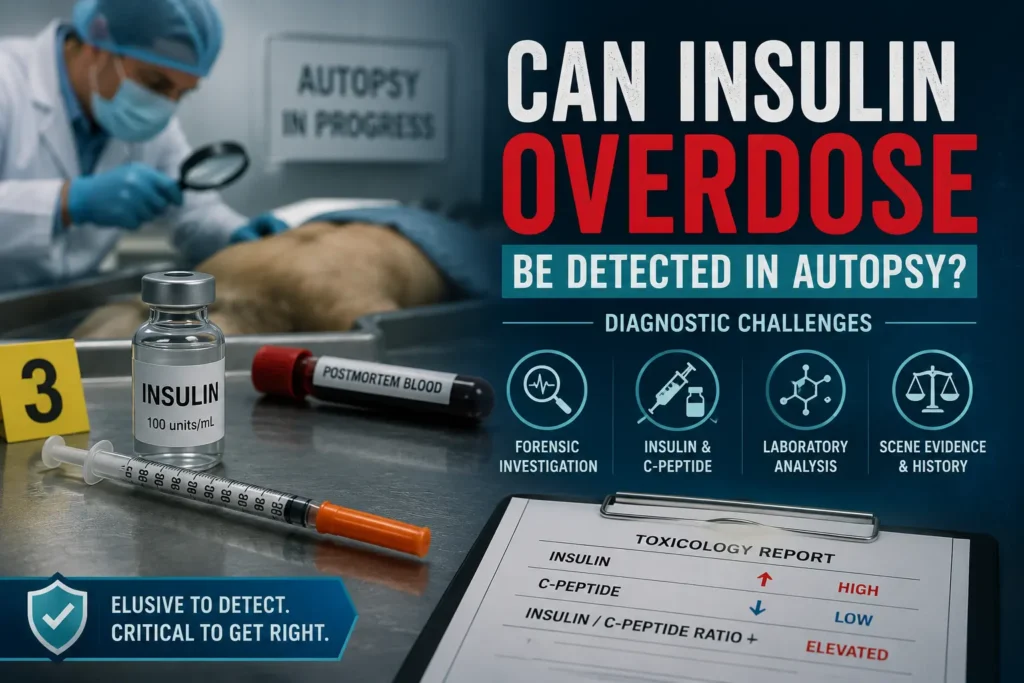
How Is Insulin Overdose Investigated at Autopsy?
When pathologists suspect insulin intoxication, they look for indirect markers of hypoglycemia, examine the body for injection marks, and measure insulin and C-peptide levels in postmortem blood samples and other fluids such as vitreous humor. They also check the scene for syringes, insulin vials, and medical devices.
Autopsy findings alone are usually insufficient to confirm insulin overdose without further evidence. No algorithm or analytical bot can replace the integration of scene data, clinical history, and toxicological analysis. In documented forensic cases from the 1990s through the 2020s-including a well-known New Mexico series involving non-diabetic decedents and European case reports-detection relied on specialized laboratories able to separate endogenous insulin from injected insulin analogues. Insulin overdose can complicate forensic death investigations precisely because organ examination rarely proves the cause of death on its own.
Basics of Insulin, Insulin Analogues, and Overdose Mechanisms
Insulin is the endogenous peptide hormone produced by the pancreas to regulate blood glucose. Exogenous insulin-both recombinant human insulin and synthetic insulin analogues-has been used therapeutically since the early twentieth century, with analogues entering the market in the late 1990s.
Common analogues include:
- Fast-acting: lispro, aspart, glulisine
- Long-acting: glargine, detemir, degludec
These analogues differ from human insulin by small amino acid substitutions, which alter their pharmacokinetics but create overlapping structures that complicate detection.
Insulin overdose causes death through severe hypoglycemia: a rapid fall in blood glucose starves the brain of energy, leading to seizures, coma, respiratory arrest, and death. Critically, this process rarely leaves specific macroscopic organ changes.
A key concept: when the body produces insulin naturally, C-peptide is released in equal amounts. C-peptide is absent in injected insulin. The insulin-to-C-peptide ratio is therefore central to distinguishing exogenous administration from the body’s own insulin production. A markedly elevated insulin level with suppressed C-peptide strongly suggests someone received insulin from an outside source.
Why Detecting Insulin at Autopsy Is So Difficult
Three factors make detection extremely complicated. First, the structural similarity between human insulin and its analogues means many routine hospital immunoassays cannot reliably distinguish one from another. In a reported Canadian case, one immunoassay platform measured insulin aspart at approximately 4,741 µU/mL while a different platform returned only about 5.2 µU/mL from the same sample-a stark demonstration of platform-dependent variability.
Second, insulin has a high molecular weight of over 2,000 Da, placing it outside the range of classical small-molecule toxicology screens designed for substances like opioids and benzodiazepines. It is one of the larger proteins that forensic labs encounter, and it ionizes poorly with standard methods. Insulin analysis is not routinely offered by most toxicology labs, leaving many jurisdictions without ready access.
Third, insulin is unstable in postmortem blood samples. Postmortem blood undergoes degradation and hemolysis, and insulin stability decreases significantly in hemolyzed blood. Bacterial activity, autolysis, and adsorption of insulin to tube walls further reduce measurable concentrations. These factors can lead to complete non-detection of insulin, even when a lethal overdose did occur. Toxicological measurement is difficult due to postmortem degradation of insulin, and this remains one of the defining challenges in forensic medicine.
Role of Scene Investigation, Medical History, and Complete Autopsy
Because laboratory proof is hard to obtain, meticulous scene and history investigation are indispensable in suspected insulin overdose cases. Insulin overdose cases often lack anatomical findings, making circumstantial evidence even more important.
Critical scene findings include:
- Syringes, needles, insulin pens, or vials (e.g., Humalog, NovoRapid, Lantus)
- Used lancets, glucose meters, and continuous glucose monitoring sensors
- Suicide notes, messages, or signs of foul play suggesting murder
Medical records-diagnosis of diabetes, prescriptions, previous suicide attempts, documented hypoglycemic episodes-help investigators determine whether insulin use was therapeutic, accidental, or intentional.
A complete autopsy in suspected cases should include a full external exam checking for injection marks, which can offer evidence of insulin administration but may be hard to detect with fine needles. The internal exam may reveal common findings such as pulmonary edema and brain swelling, though these are nonspecific. Specialized toxicology sampling may include vitreous humor and injection site tissues, along with femoral blood, cardiac blood, and urine. In the two cases reported from the Netherlands in 2024, investigators found that without adequate specimen collection and lab capability, even strong scene evidence could not be confirmed analytically.
Laboratory Strategies in Postmortem Investigations of Insulin Overdose
Modern forensic workups follow a multi-step approach: initial broad toxicology screening, targeted insulin and C-peptide measurements, and-when needed-advanced mass spectrometry for determination of specific analogues. Mass spectrometry is used to distinguish natural insulin from synthetic analogs, and high-resolution mass spectrometry can discriminate insulin types at the molecular level, even when their structures differ by a single amino acid.
Preferred specimens include peripheral (femoral) blood for insulin testing and C-peptide analysis, and vitreous humor for glucose assessment. Vitreous humor is often analyzed because it is less affected by decomposition than blood. Tissue samples from liver, kidney, muscle, or injection sites may also be collected when blood is unavailable or compromised.
Interpretation of results requires context. In non-diabetics, markedly elevated insulin with suppressed C-peptide strongly points to exogenous insulin. In diabetics on therapy, results are more ambiguous and must be correlated with dose, timing, and treatment records. The insulin-to-C-peptide ratio is key in detecting exogenous insulin overdose.
Insulin detection is not routinely offered by most forensic labs. In practice, samples may need to be shipped to reference centers-often in the USA or Europe-and results can be delayed by months. Authors of a 2024 review funded under SWGTOX guidelines are working to establish standardized therapeutic versus overdose concentration ranges, but this work is still continuing.
Time, Sample Handling, and Interpretation Pitfalls
The time factor dominates every aspect of this analysis. The interval between injection and death, death and sampling, and sampling and analysis all influence what can still be measured. Insulin concentrations can degrade significantly postmortem, and insulin is unstable in postmortem blood samples regardless of the cause of death.
Consider two contrasting scenarios: a massive intravenous overdose discovered within hours in a hospital setting (short interval, higher chance of detection) versus a subcutaneous overdose found days later in an unrefrigerated home (long interval, minimal measurable insulin despite a lethal event). Postmortem insulin concentration can be affected by sample storage conditions, and blood glucose changes after death further complicate interpretation of postmortem glucose levels.
Best-practice preservation steps recommended in forensic literature include:
- Rapid centrifugation and use of low-binding protein tubes with appropriate preservatives
- Storage at controlled temperature (−20 °C or lower)
- Minimizing freeze–thaw cycles to protect sample integrity
With regard to interpretation, even therapeutic-range insulin levels at autopsy do not necessarily exclude overdose, because postmortem loss may have dramatically lowered the detectable concentration. In a 2024 French case, lispro was found at only 1.1 ng/mL-a therapeutic level-yet overdose could not be excluded based on scene evidence and medical history. Insulin and C-peptide tests require careful specimen handling due to insulin degradation after death. Background therapeutic use in diabetics, variable last dose, and overlapping analytical signals make the determination even more complicated. Each case demands that investigators follow a holistic review of all available evidence rather than relying on a single number.
Can We Reliably Prove Insulin Overdose Today? Practical Conclusions
As of the mid-2020s, our collective knowledge has advanced substantially, but significant uncertainty persists in many individual cases. When high-quality postmortem samples are collected promptly and analyzed with specific methods, forensic teams can sometimes clearly demonstrate the presence of exogenous insulin and support a diagnosis of insulin intoxication as a cause of death.
In other cases-especially those with delayed discovery, poor storage, or limited lab access-the conclusion may remain “suspected insulin overdose” rather than definitively proven, and the manner of death may be categorized as undetermined.
For clinicians, investigators, and families: early suspicion matters. Careful documentation of diabetes management devices, prompt communication with forensic services, and proper specimen collection are the most actionable steps anyone can take. Emerging technologies-including more robust LC-MS platforms, tissue-based proteomics, metabolomic profiling, and standardized protocols now in development-offer hope that the coming decade will improve the reliability of detecting insulin overdose postmortem. This work is continuing across laboratories worldwide, and the need for validated, accessible methods has never been clearer.
Patients prescribed insulin should always obtain their medication from trusted providers, and many choose to buy Canadian insulin online through licensed pharmacies that follow strict quality and shipping requirements.
Frequently Asked Questions (FAQs)
The following questions address practical concerns not fully covered in the main sections above.
Can a normal-looking autopsy still be consistent with fatal insulin overdose?
Yes. Hypoglycemia kills through functional brain failure rather than producing distinctive structural lesions. Organs may appear largely normal at autopsy. The lack of gross pathology changes does not rule out insulin intoxication, which is precisely why toxicological analysis and scene investigation are so critical in these cases.
How long after death can insulin overdose still be detected?
There is no fixed cutoff. With rapid cooling and freezing, insulin or its analogues may be measurable for months in properly stored specimens. However, in warm or delayed conditions, insulin can become undetectable within days due to degradation and adsorption. The quality of the postmortem samples and the speed of collection are the most important factors.
Do courts accept insulin measurements as proof of homicide or suicide?
Courts evaluate the totality of evidence. Markedly abnormal insulin-to-C-peptide ratios, identified analogues, and supportive scene findings can be persuasive. However, because of analytical uncertainties and the limitations reported in forensic literature, convictions or legal rulings rarely rest on insulin levels alone.
Is it easier to detect overdose with insulin analogues than with human insulin?
In some ways, yes. Modern LC-HRMS methods can distinguish several analogues from endogenous human insulin at the molecular level, which may actually make some analogue overdoses more identifiable than those involving older human insulin preparations-provided the lab has the right technology and validated standards.
Can family members request specific testing for suspected insulin overdose?
In many jurisdictions, relatives can raise concerns with the coroner, medical examiner, or forensic pathologist. Decisions about additional insulin testing depend on legal authority, whether suitable specimens were collected and retained, and the feasibility of accessing specialized analysis at a qualified laboratory.
