

The Electrocardiogram (ECG/EKG): From Basic Electrophysiology to Artificial Intelligence
Every second, your heart generates a tiny electrical signal—long before it physically beats. Invented by Willem Einthoven in 1903 (Nobel Prize 1924), the ECG remains the most performed cardiovascular test worldwide: non-invasive, affordable, and incredibly informative.
For Patients
Painless, 5-minute test. No radiation. Learn what the squiggly lines mean for your heart health.
BaselineFor Students
P waves, QRS, intervals, axis deviation, 300 method — master the fundamentals.
Core CurriculumFor Professionals
STEMI patterns, electrolyte clues, drug effects, AI integration in 2025.
AdvancedFuture Tech
Digital twins, contactless radar, deep learning prediction of sudden death.
2030+
The Plumbing vs. Electricity Analogy
Think of your heart as a house: the plumbing = blood vessels and chambers (what doctors hear with a stethoscope). The electricity = the wiring. Without electricity, the pump won’t work. An ECG is a wiring diagram — it listens to your heart’s natural electricity using stickers (electrodes) on your skin. It does not send electricity into you.
- ✅ Non-invasive, no electricity sent into you
- ✅ 10 electrodes, 12 views, <5 minutes
- ✅ Detects arrhythmias, ischemia, electrolyte issues
- ✅ Painless, zero radiation
Morphological Waveform Renderer
Use the professional control console below to choose preset clinical conditions, or fine-tune individual wave attributes using the custom parameters interface. The virtual monitor renders continuous real-time Lead II vector data on standard clinical grid paper coordinates.
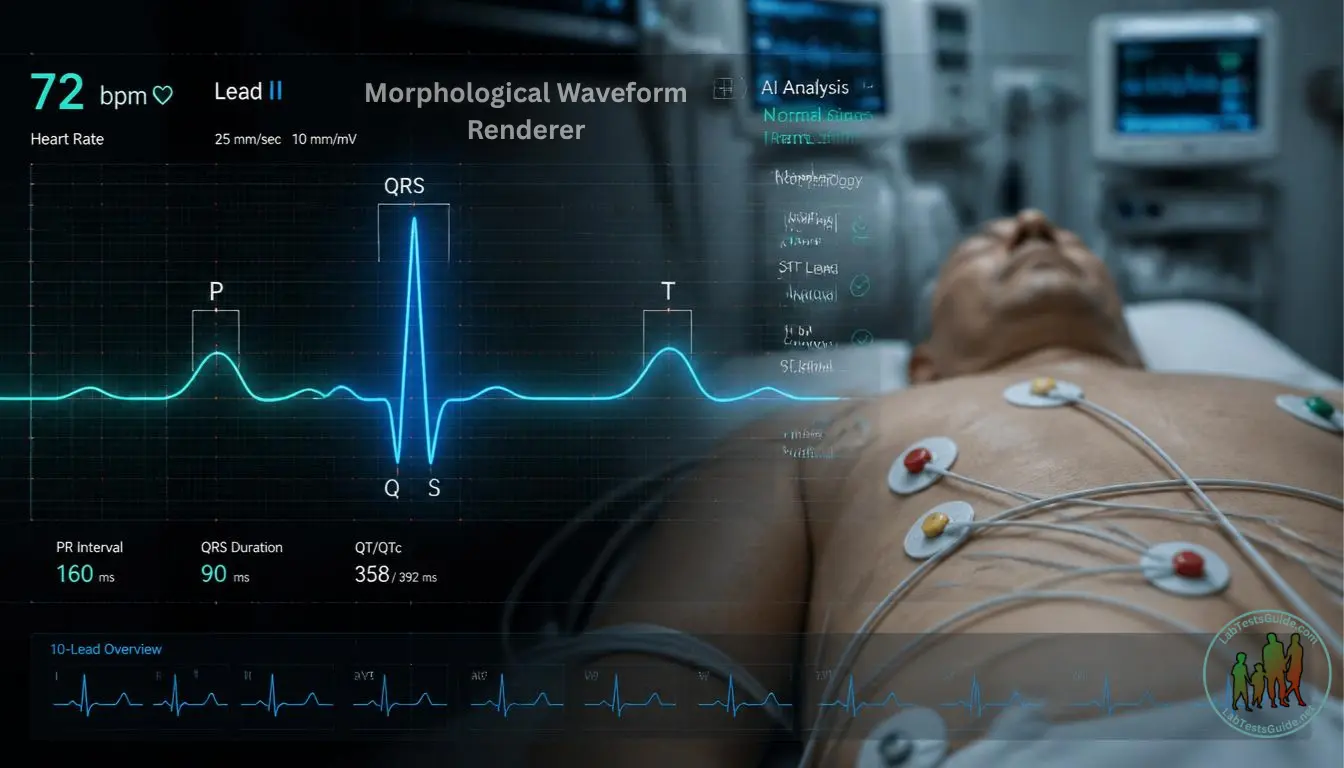
The waveform exhibits standard electrophysiological traits. Every P wave matches a QRS complex, verifying an intact, unhindered Sinoatrial to Atrioventricular node pathway. ST segment rests cleanly on the isoelectric baseline.
🩺 Select Clinical Condition Preset
⚙️ Custom Attribute Micro-Controls
Manually altering any parameter transitions the tracking status into “Custom Configuration Mode”.
Why Would a Doctor Order an ECG?
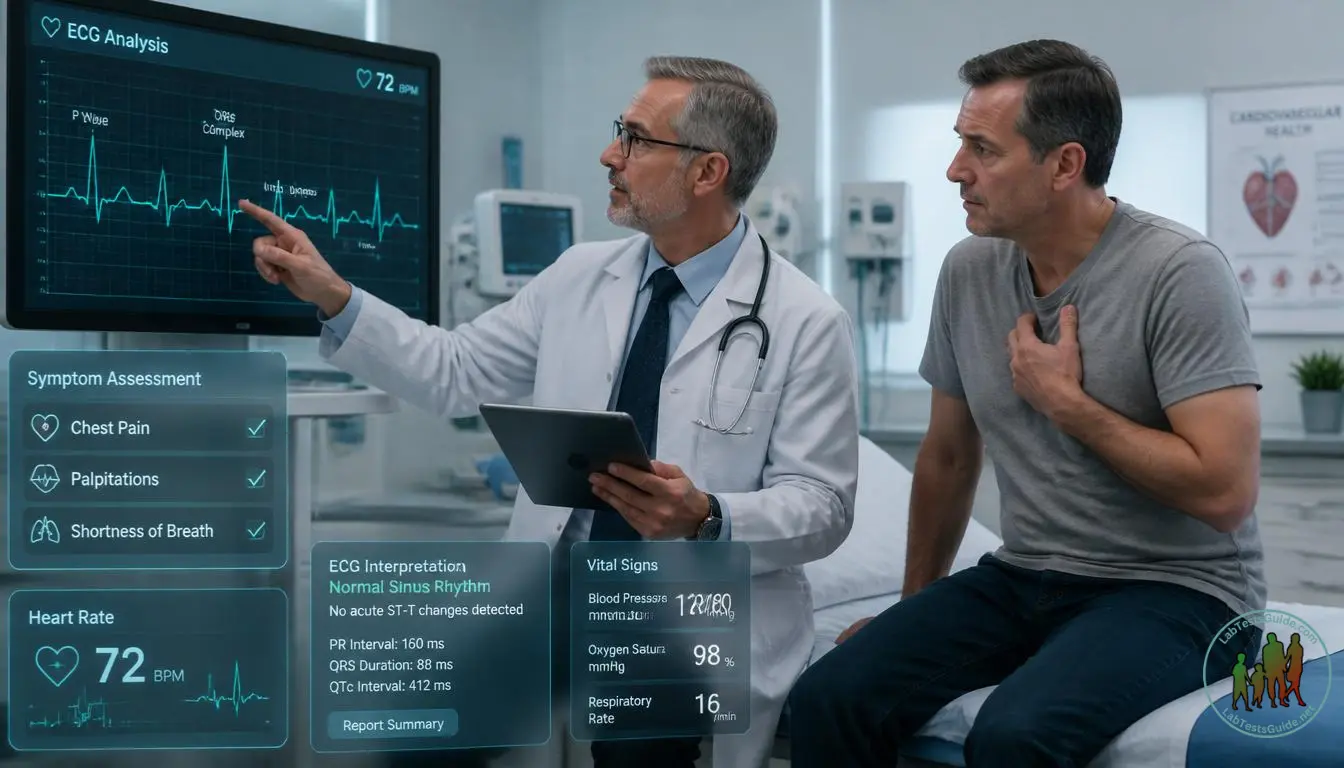
| Symptom/Reason | What the ECG checks for |
|---|---|
| Chest pain | Heart attack (STEMI vs NSTEMI) |
| Palpitations | Arrhythmias (e.g., atrial fibrillation) |
| Shortness of breath | Heart strain or failure |
| Before surgery | Baseline heart health |
| Fainting (syncope) | Dangerous rhythm pauses |
| Routine checkup | Silent heart issues |
The Visual Language of the ECG (Graph Paper & Waves)
Understanding the Grid: ECG paper runs at 25 mm/second. Horizontally (time): 1 small box = 0.04 seconds. 1 large box (5 small) = 0.20 seconds. Vertically (voltage): 1 small box = 0.1 mV. 1 large box = 0.5 mV.
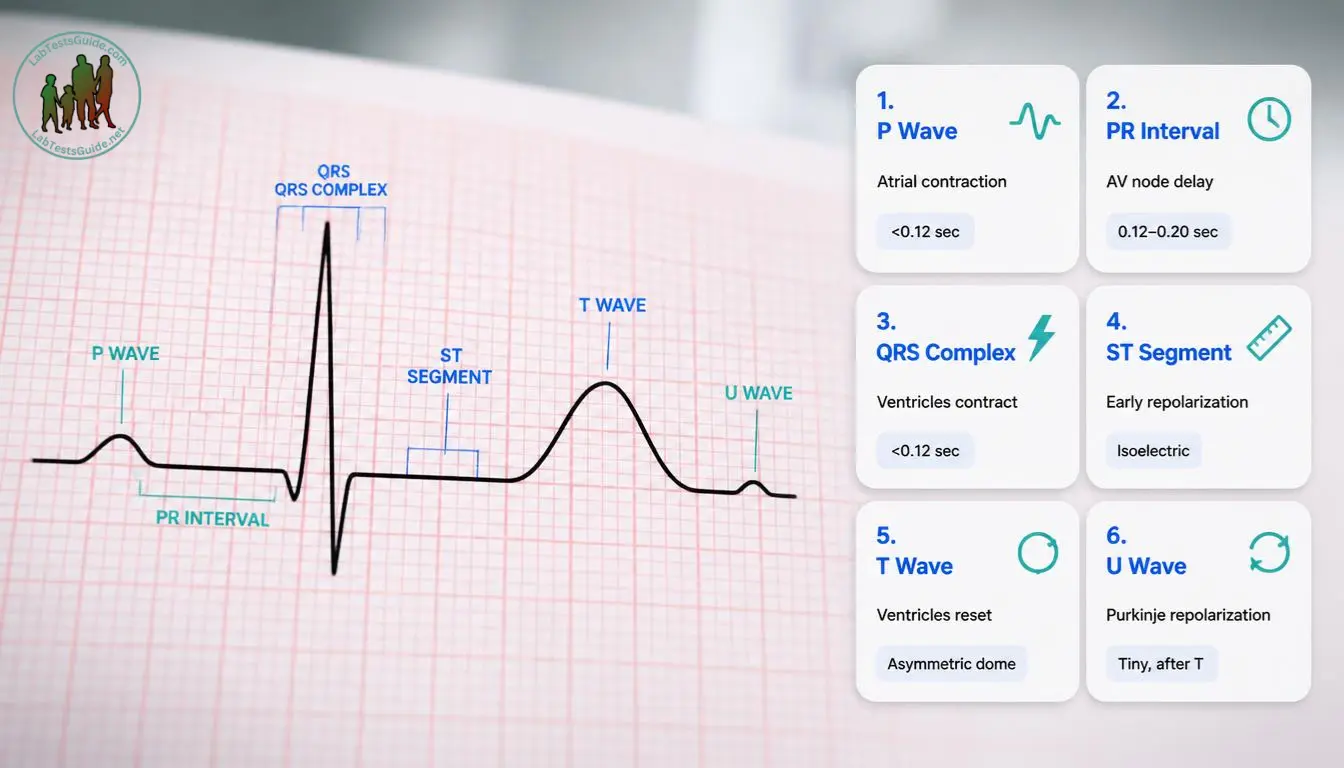
P Wave
Atrial contraction
<0.12 sec
PR Interval
AV node delay
0.12–0.20 sec
QRS Complex
Ventricles contract
<0.12 sec
ST Segment
Early repolarization
Isoelectric
T Wave
Ventricles reset
Asymmetric dome
U Wave
Purkinje repolarization
Tiny, after T
Clinical pearl: No P wave? Consider atrial fibrillation. Wide QRS (>0.12 sec)? Ventricular origin.
Deep Explanation: Cellular Basis, 12-Lead, Rate, Axis
⚡ Depolarization & Repolarization
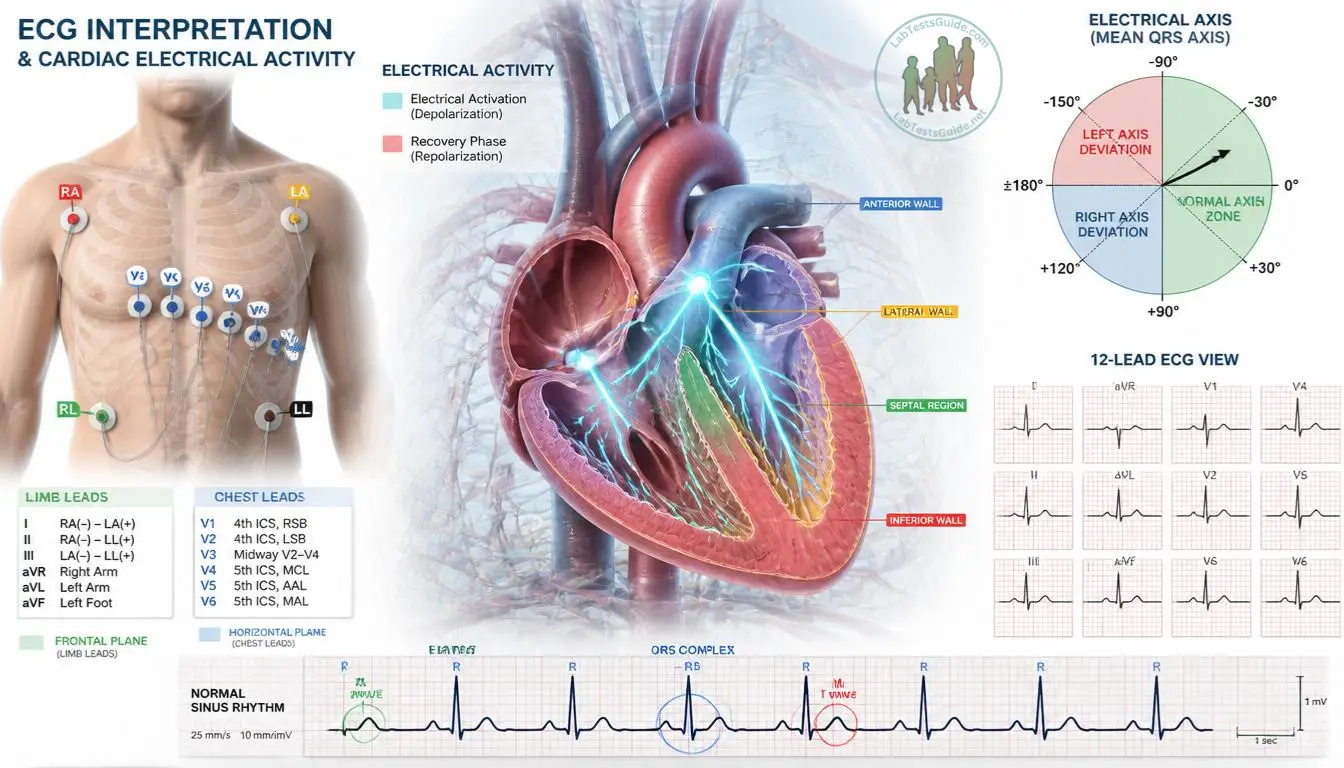
Resting cell: inside negative (−90 mV) relative to outside. Depolarization (activation): Sodium rushes in → cell becomes positive → contraction. Repolarization (recovery): Potassium leaves → cell returns to negative. ECG records the sum of millions of cells depolarizing/repolarizing, not a single cell.
📍 The 12-Lead ECG – Not Just 12 Wires
Limb (frontal plane): I, II, III, aVR, aVL, aVF → Inferior (II, III, aVF), Lateral (I, aVL).
Precordial (horizontal): V1-V6 → Septal (V1-2), Anterior (V3-4), Lateral (V5-6).
Inferior MI → changes in II, III, aVF. Anterior MI → V3-V4. Posterior MI → tall R wave in V1-V2 (mirror image).
❤️ Calculating Heart Rate – Three Methods
- 300 method (regular): 300 ÷ number of large boxes between two R waves.
- 1500 method (precise): 1500 ÷ number of small boxes between R-R.
- 6-second method (irregular): Count R waves in 30 large boxes (6 sec) × 10.
📐 Axis Determination
QRS axis = average direction of ventricular depolarization. Normal: −30° to +90°.
Left axis deviation (−30° to −90°): left anterior fascicular block, inferior MI.
Right axis deviation (+90° to +180°): right ventricular hypertrophy, pulmonary embolism.
Quick thumb rule: Leads I and aVF both positive → normal axis. Lead I positive, aVF negative → left axis. Lead I negative, aVF positive → right axis.
Recognizing Common Pathologies (For Professionals)
Ischemia & Infarction
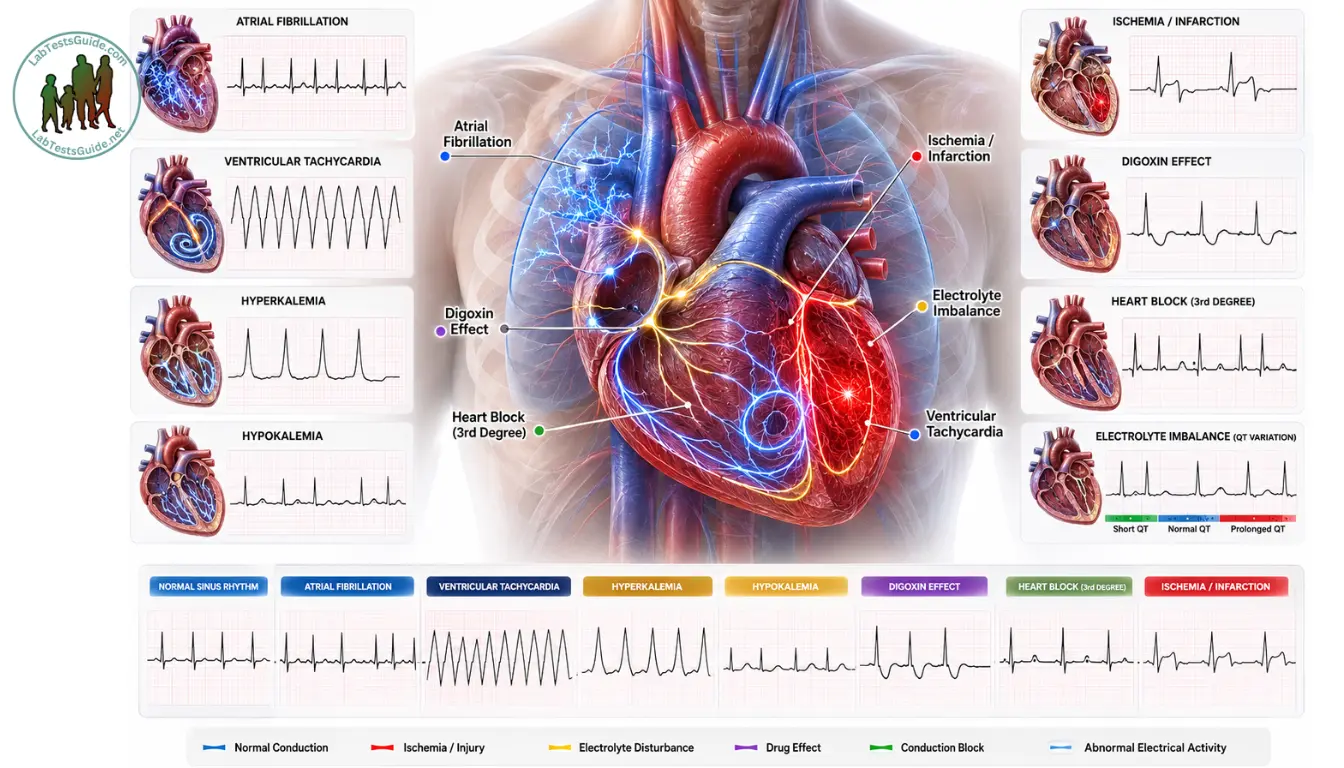
Hyperacute T waves (first minutes of STEMI) → ST elevation (≥1 mm limb, ≥2 mm chest) → pathologic Q waves (≥0.04 sec or ≥25% of QRS). ST depression = subendocardial ischemia (NSTEMI).
Atrial Fibrillation
Irregularly irregular, no P waves, rate 100-180. Thromboembolic risk ↑. Confirm with rhythm strip.
Ventricular Tachycardia
Wide QRS >0.12, rate 120-250, no P waves. Hemodynamically unstable → immediate cardioversion.
Hyperkalemia
Tall peaked T → wide QRS → sine wave → cardiac arrest. Serum K⁺ >6.5 mEq/L. Calcium gluconate first line.
Hypokalemia
Prominent U waves, flat T, long QU interval.
Digoxin Effect
Downsloping ST depression (Salvador Dali sign), short QT, arrhythmias.
3rd Degree Heart Block
Atrial and ventricular dissociation, rate 30-40. Pacemaker indicated.
Hypercalcemia / Hypocalcemia
Hypercalcemia → short QT. Hypocalcemia → long ST segment (prolonged QT).
Evolution of ECG Technology: From String Galvanometer to AI
Latest Clinical Breakthroughs (2023–2025)
- AI ECG for Low Ejection Fraction: A standard 12-lead ECG screens for weak heart pump (EF<35%) with 85% accuracy – no echocardiogram needed.
- Smartwatch detection of atrial fibrillation: Apple Heart Study (n=419,000) showed positive predictive value of 84% for irregular rhythm.
- Portable single-lead devices: KardiaMobile 6L – FDA-cleared for QT monitoring and wide QRS detection.
Futuristic ECG – What’s Next?
Summary Tables for Quick Reference
Normal ECG Values (Adult)
| Parameter | Normal Range |
|---|---|
| Heart rate | 60–100 bpm |
| P wave duration | <0.12 sec |
| PR interval | 0.12–0.20 sec |
| QRS duration | <0.12 sec |
| QTc (men/women) | <0.44 sec / <0.46 sec |
| QRS axis | −30° to +90° |
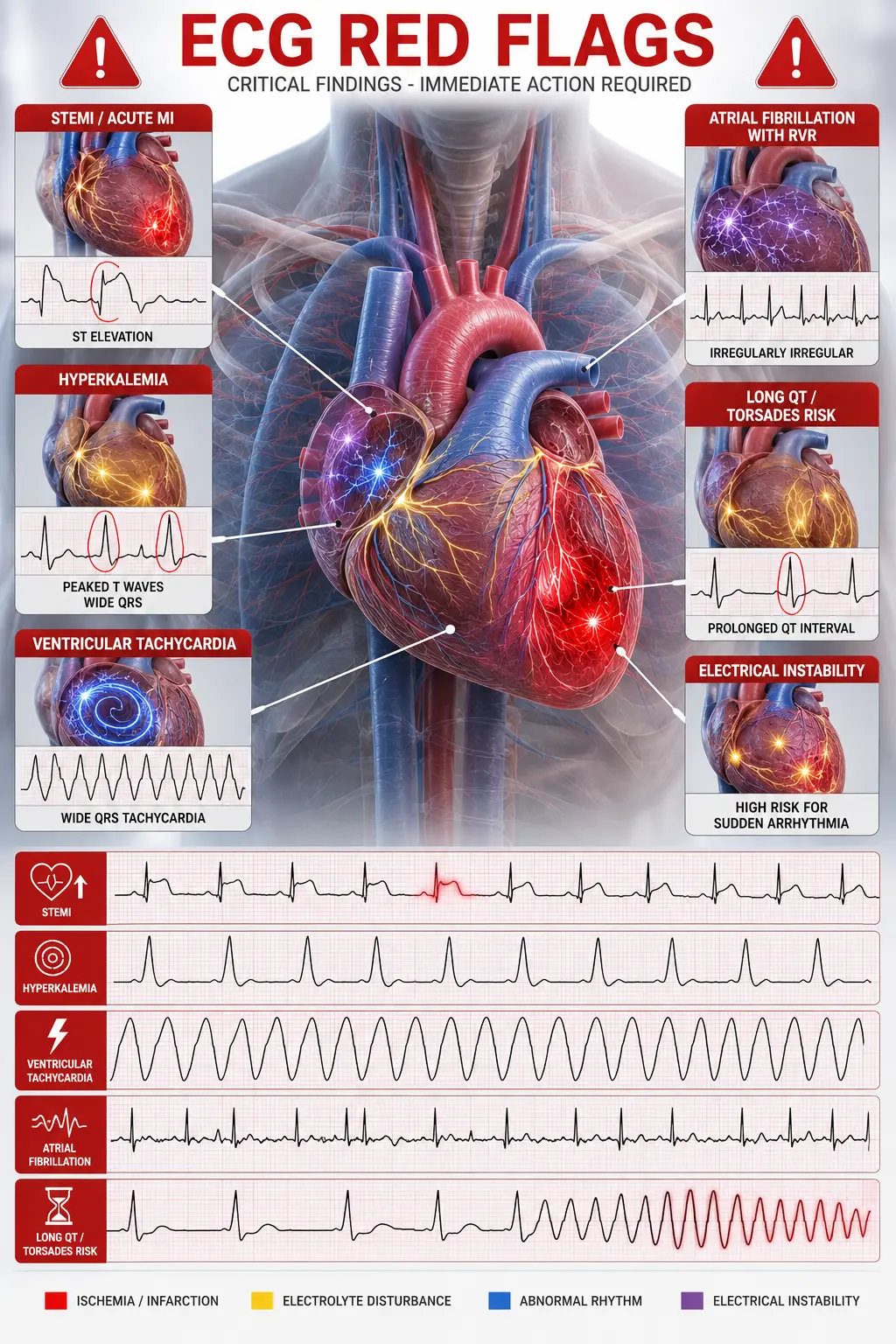
Red Flags on ECG (Must-Notify Clinician Immediately)
| Finding | Implication |
|---|---|
| ST elevation ≥1 mm in two contiguous leads | Possible STEMI |
| Tall, peaked T waves + wide QRS | Hyperkalemia (potentially fatal) |
| Ventricular rate >150 with wide QRS | Ventricular tachycardia |
| No P waves + irregularly irregular | Atrial fibrillation with RVR |
| Long QT (>0.50 sec) + Torsades | Risk of sudden death |
🩺 ECG vs Echocardiogram vs Angiography
ECG: Electrical activity (wiring).
Echocardiogram: Heart structure (ultrasound).
Angiography: Blood vessel blockages (contrast).
Stress Test: Heart under exercise.
⌚ Can a Smartwatch Replace a Hospital ECG?
No. A smartwatch is usually a “1-lead” view (one angle). A hospital “12-lead” ECG gives a full 3D picture. Smartwatches are excellent for screening AFib but cannot reliably rule out a heart attack.
Frequently Asked Questions (FAQ)
No. It misses valvular disease (use echocardiogram) and blocked coronary arteries without symptoms (use stress test).
Not necessarily. A normal ECG does not rule out unstable angina or microvascular disease. See a cardiologist.
Yes. No radiation. No electricity injected. It’s pure recording.
Early repolarization: J-point elevation with upward concave ST, often in young athletes. STEMI: convex (tombstone) ST, reciprocal depression, dynamic change.
Calling a rhythm “sinus tachycardia” when it’s actually atrial flutter with 2:1 block (look for sawtooth waves in V1 or inferior leads).
Compare to old ECG: new Q waves, new bundle branch block, or subtle ST changes clarify acute vs chronic findings.
Not yet. AI excels at pattern recognition (LVH, low EF) but misses clinical context (hyperventilation mimics ischemia). Human oversight remains mandatory.
None. EKG is from the German “Elektrokardiogramm.” They are identical tests.
No, it is completely painless. The stickers only listen to your heart’s natural electricity.
Yes. Scar tissue does not conduct electricity, leaving a permanent “electrical shadow” — typically a pathological Q-wave.
The ST segment represents the window where ventricles are fully depolarized. If the heart muscle is starving for oxygen (heart attack), the electrical injury pattern shifts this segment off baseline.
In an era of CT angiograms, cardiac MRI, and genetic testing, the ECG remains the stethoscope of the 21st century — ubiquitous, cheap, and rich with data. For the patient, it’s reassurance or a call to action. For the student, it’s a puzzle of waves and intervals. For the professional, it’s a split-second decision tool for life and death. And with AI and wearables, the ECG is becoming smarter, continuous, and predictive. Learn to read it well. The heart never stops talking.
