

Your cotton pillowcase is a bacterial breeding ground. It sounds disgusting. It is. Every single night, you press your face into a highly absorbent sponge. It collects dead skin cells, sweat, and environmental dust for eight solid hours.
Most people blame their expensive serums or hormonal shifts for sudden breakouts.
They are looking in the wrong place. Here is the truth. The real culprit is the micro-environment sitting directly under your cheek. When dermatologists analyze clinical-grade silk pillowcases in laboratory settings, the data destroys our assumptions about clean laundry. Standard cotton and synthetic fabrics fail miserable tests for skin hygiene and structural integrity.
It is time to stop guessing. We need to look at the hard science. We have to understand exactly why dermatologists and trichologists recommend specific natural proteins for cellular repair.
The Microscopic Problem: Why Cotton Causes Breakouts
Cotton is engineered by nature to absorb moisture. Think about it. You use cotton towels to dry off after a shower. You wear cotton in the summer to soak up sweat. It is a highly porous material.
When you sleep on a standard cotton pillowcase, it pulls moisture directly from your epidermis. It also sucks up your night creams. This creates a damp, nutrient-rich environment deep within the fibers.
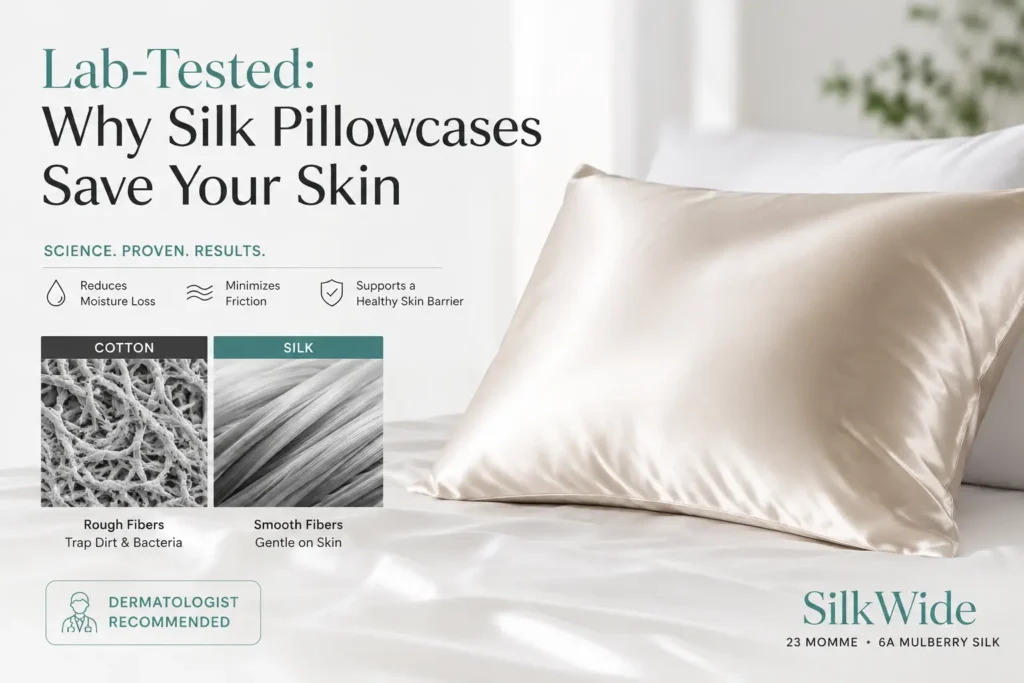
Bacteria multiply rapidly in this environment. You are essentially creating a petri dish. Every time you flip your pillow, you expose your pores to yesterday’s microbial growth. Cotton fibers are also surprisingly rough under a microscope. They create immense friction against your skin barrier, leading to micro-abrasions that trigger inflammation and redness.
We wash our face twice a day to remove impurities. Then we immediately lay on a surface that spent the last three nights collecting them. The math simply does not add up for clear skin.
Transepidermal Water Loss (TEWL) Explained
Dermatologists talk constantly about the skin barrier. When your barrier is compromised, water escapes your skin easily. This process is called Transepidermal Water Loss, or TEWL.
High TEWL leads to dry, flaky, and easily irritated skin. Cotton accelerates this process aggressively. Because it is so highly absorbent, it actively wicks hydration away from your face while you sleep. You can apply the thickest, most expensive moisturizers on the market.
It will not matter. The cotton will drink it before your skin can absorb it. You wake up with a dry face and a very well-moisturized pillowcase. This is a massive waste of your skincare budget.
The Synthetic Satin Lie: Sleeping on Plastic
Then we have satin. Cheap satin is aggressively marketed as a beauty hack. Do not fall for it.
Satin is not a material; it is a weave. Most affordable satin pillowcases are woven from polyester. Polyester is literally plastic. Sleeping on synthetic satin completely disrupts your body’s natural thermal regulation.
It traps heat instantly. It prevents your skin from breathing, leading to clogged pores and trapped sweat. Under a microscope, synthetic fibers look jagged and irregular. They grip your hair cuticles like sandpaper.
Instead of protecting your hair, polyester creates mechanical friction. This friction inevitably leads to split ends and severe breakage over time. You are suffocating your pores to save a few dollars on bedding.
The Biomechanics of Sleep Wrinkles
Mechanical stress accelerates physical aging. It really is that simple.
When you toss and turn on a rough surface, you inflict micro-trauma on your facial tissue. Over eight hours, this repeated dragging and pulling breaks down the collagen matrix in your skin. These are called sleep wrinkles. Unlike expression lines from smiling or frowning, sleep wrinkles show up in bizarre places like the middle of your cheeks.
Over time, these temporary creases become permanent static wrinkles. The skin loses its ability to snap back. This is entirely preventable.
By eliminating the friction coefficient of your sleep surface, you eliminate the cause of the wrinkles. It is basic physics applied to dermatology.
The Biological Superiority of Natural Mulberry Silk
True natural silk operates on an entirely different biomechanical level. It is a natural protein fiber composed primarily of fibroin.
This unique molecular structure makes silk naturally hypoallergenic. It naturally repels dust mites, fungus, and mold. Unlike cotton, silk has an incredibly low absorption rate. It leaves your natural moisture exactly where it belongs: inside your skin.
When your skin retains its natural moisture barrier, TEWL drops significantly. Your nighttime skincare products actually stay on your face to do their job. You wake up hydrated. The clinical difference in skin elasticity after just thirty days of sleeping on a non-absorbent surface is staggering.
Trichology and Hair Health: The Cuticle Preservation Test
Your hair is incredibly fragile when you are asleep. The outer layer of your hair, the cuticle, looks like overlapping roof shingles under high magnification.
Rough fabrics force those shingles open. When the cuticle is lifted, moisture escapes. The hair shaft weakens. The result is chronic frizz, massive tangles, and sudden breakage. This is exactly why you wake up with bedhead.
A high-grade silk sleep surface acts differently. It forces those shingles to lie flat. This seals in moisture and protects the structural integrity of every single strand. Your hair simply glides across the surface, completely eliminating the mechanical stress that ruins blowouts and causes split ends.
Decoding Silk Metrics: The Momme Weight
The grade of the material dictates the results. You cannot buy a cheap, thin silk blend and expect clinical-level benefits. The industry standard for maximum biomechanical benefit is strictly 23 Momme.
So, what exactly is a Momme? Think about it like thread count for cotton, but far more accurate. “Momme” is the unit used to measure silk density and weight. A standard silk shirt might be around 8 to 12 Momme. That is far too thin and fragile for bedding.
A 23 Momme rating means the fabric is dense, highly durable, and features an incredibly tight weave. This specific combination drastically reduces the friction coefficient to its absolute lowest point. Anything less than 23 Momme will wash poorly, wear out quickly, and fail to provide the structural support your skin and hair require.
The Grade 6A Standard: Purity Under the Microscope
Momme is only half the equation. The quality of the actual silk thread is equally important.
Silk is graded on a scale from A, B, and C, with A being the highest. Within the A category, it is further numbered from 1 to 6. Grade 6A is the highest possible quality rating for silk fibers in the world.
To achieve a 6A rating, the silk threads must be long, uniform, and completely pure. There are no broken fibers. There are no structural weaknesses. When you combine a 6A purity rating with a 23 Momme weight, you get a textile that operates more like a medical-grade sleep surface than a standard pillowcase.
This is the exact specification needed to stop hair breakage and prevent transepidermal water loss.
The Financial Math of Sleep Hygiene
Let us talk about the economics of your nighttime routine. You likely spend hundreds of dollars a year on moisturizers, acne treatments, and hair masks.
If you apply a fifty-dollar night cream and immediately sleep on a cotton pillowcase, the cotton absorbs at least half of it. You are literally throwing money away while feeding the bacteria on your bed. The return on investment for your skincare plummets.
Investing in a high-grade silk sleep surface protects your other investments. It allows your expensive serums to actually penetrate your skin barrier. It extends the life of your blowouts, saving you money on styling products and salon visits. Over a single year, a proper silk pillowcase pays for itself purely in the skincare product it saves.
Setting the Standard for Clean Sleep
The market is flooded with deceptive labeling. Brands constantly pass off synthetic blends as “silky” to capitalize on the science without providing the actual benefits.
Other companies charge astronomical markups for basic quality, treating sleep hygiene like an exclusive luxury. You want accessible premium products, not overpriced designer goods. You want clinical results without the retail bloat.
This is where brands like SilkWide change the equation entirely. By strictly utilizing 23 Momme, 6A grade Mulberry silk for all their core products, they provide the exact specifications required to see measurable changes.
Stop paying for extensive skincare routines if you are just going to wipe them off on a cotton sponge every night. Stop sleeping on plastic. Upgrade your sleep surface to clinical-grade materials. Your skin barrier will thank you.
