

As interest in longevity science grows, Nicotinamide Mononucleotide (NMN) has emerged as one of the most discussed compounds in the field. While much of the attention focuses on its potential to support NAD+ levels, a more practical question often follows: how much NMN should an individual actually take?
Unlike conventional medications, NMN does not yet have universally established dosage guidelines. Instead, recommendations are derived from a combination of clinical trials, preclinical data, and mechanistic understanding of metabolism. Factors such as age, body weight, metabolic health, and lifestyle all play a role in determining how NMN may be used effectively.Why Dosage Matters in NAD+ Restoration
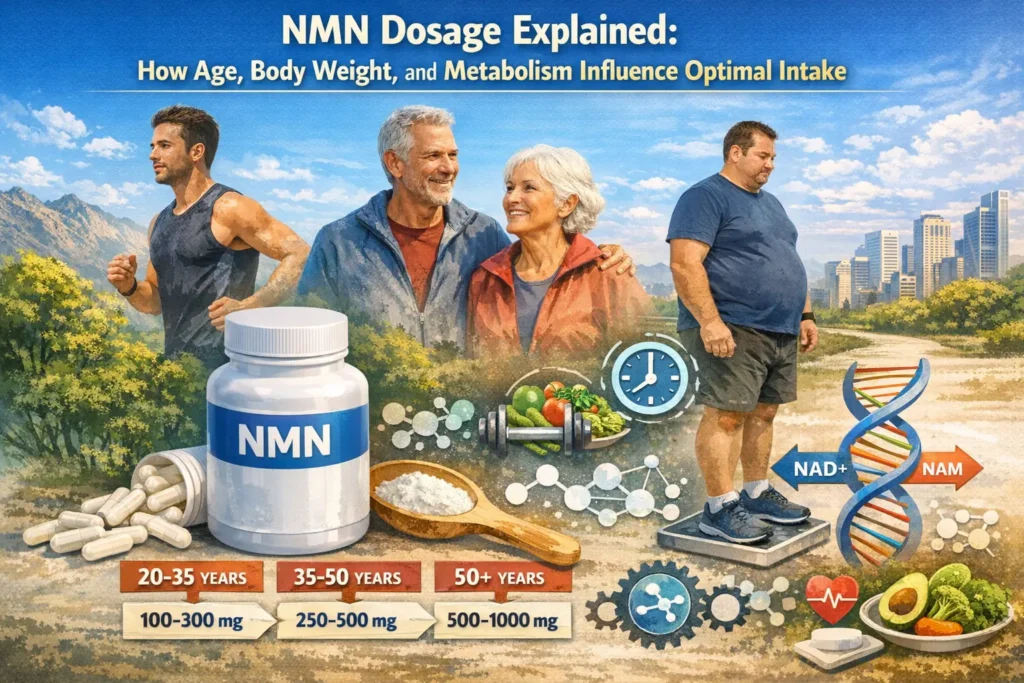
NMN functions as a precursor to NAD+, a coenzyme central to energy metabolism, DNA repair, and cellular signaling. However, NAD+ levels decline progressively with age, meaning the same NMN dose may not have identical effects across different individuals.
The goal of NMN supplementation is not simply to introduce more of the compound into the body, but to support efficient NAD+ synthesis without overwhelming metabolic pathways. This balance is important because NAD+ metabolism produces byproducts—such as nicotinamide—that must be processed through additional biochemical systems.Age-Based NMN Dosage Considerations 20–35 Years: Maintenance Phase
Younger individuals typically have relatively stable NAD+ levels. For this group, NMN is less about correction and more about maintenance.
- Typical range: 100–300 mg per day
- Purpose: Support cellular efficiency and metabolic resilience
- Consideration: Lifestyle factors (sleep, exercise, diet) play a larger role than supplementation
In many cases, dietary and lifestyle optimization may provide similar benefits at this stage.35–50 Years: Early Decline Phase
This age range is where NAD+ levels begin to show measurable decline in observational studies.
- Typical range: 250–500 mg per day
- Purpose: Support energy metabolism, recovery, and early aging pathways
- Consideration: Stress, sedentary habits, and diet can influence requirements
At this stage, NMN may begin to complement declining cellular processes rather than simply maintaining them.50+ Years: Restoration Phase
Older individuals generally experience more pronounced reductions in NAD+ levels, along with changes in mitochondrial function and cellular repair capacity.
- Typical range: 500–1000 mg per day
- Purpose: Support mitochondrial efficiency, physical endurance, and metabolic health
- Consideration: Individual response may vary significantly
Some human trials have explored doses within this range, showing improvements in muscle function and metabolic markers, though long-term outcomes remain under investigation.Body Weight and Metabolic Scaling
While age provides a general framework, body weight introduces another layer of personalization. NMN metabolism is influenced by overall body mass and energy demand.General Guideline by Weight
- Under 60 kg: 100–300 mg per day
- 60–80 kg: 250–500 mg per day
- 80–100 kg: 400–750 mg per day
- Over 100 kg: 500–1000 mg per day
These ranges are not strict rules but serve as scaling references. Individuals with higher body mass may require slightly higher intake to achieve similar systemic effects, particularly in tissues with high energy demand.Timing and Absorption Considerations
NMN is commonly taken in the morning due to its association with cellular energy production and circadian rhythm regulation. Some individuals report increased alertness, making late-day dosing less desirable.
Splitting the dose—morning and early afternoon—may help maintain stable NAD+ availability throughout the day. However, there is no definitive clinical consensus on timing strategies.
Bioavailability also varies depending on delivery method, digestive factors, and individual physiology. While oral NMN is widely used, ongoing research continues to explore how efficiently it reaches systemic circulation and specific tissues.The Overlooked Factor: Metabolic Byproducts
One important but often under-discussed aspect of NMN supplementation is what happens after NAD+ is utilized. As NAD+ participates in cellular reactions, it generates nicotinamide (NAM), which must be cleared or recycled.
This process can involve methylation pathways—biochemical systems responsible for transferring methyl groups to various molecules. Increased NAD+ turnover may increase demand on these pathways, particularly at higher NMN doses.
This is where discussions around combining NMN with methyl donors emerge. For a detailed explanation of this interaction, including the biochemical reasoning behind it, see NMN with TMG, which explores how methylation support may complement NMN metabolism.Adjusting Dosage Based on Lifestyle
NMN dosage is not static. It can be influenced by:
- Physical activity levels (higher energy demand may increase NAD+ turnover)
- Diet quality (availability of B vitamins and methyl donors)
- Sleep patterns (circadian rhythm impacts NAD+ metabolism)
- Alcohol and smoking (can increase oxidative stress and metabolic load)
For example, individuals with physically demanding routines may require slightly higher NMN intake compared to sedentary individuals of the same age and weight.Safety and Practical Approach
Current human studies suggest that NMN is generally well tolerated within commonly used ranges (approximately 250–1000 mg per day). Reported side effects are typically mild and may include digestive discomfort in some individuals.
However, long-term data is still limited. A cautious, evidence-based approach is advisable:
- Start with a lower dose
- Monitor subjective responses (energy, sleep, digestion)
- Adjust gradually if needed
- Consider periodic evaluation of biomarkers where possible
It is also important to recognize that NMN is not a substitute for foundational health practices such as balanced nutrition, physical activity, and adequate sleep.Conclusion
NMN dosage is not a one-size-fits-all recommendation. It exists at the intersection of age-related decline, body weight, metabolic demand, and individual lifestyle factors. Understanding these variables allows for a more informed and personalized approach to supplementation.
Rather than focusing solely on higher doses, the more effective strategy is to align NMN intake with the body’s actual needs—supporting NAD+ levels while maintaining balance across related metabolic pathways.
As research continues to evolve, dosage strategies will likely become more refined. For now, a measured, adaptive approach remains the most scientifically grounded way to incorporate NMN into a broader longevity framework.