

Framingham Risk Score (FRS) Calculator
The Framingham Risk Score (FRS) is a widely utilized clinical tool designed to estimate a patient’s 10-year risk of developing general cardiovascular disease (CVD). Developed from the landmark Framingham Heart Study, it considers key demographic and metabolic factors to help clinicians decide on lifestyle interventions or lipid-lowering therapies.
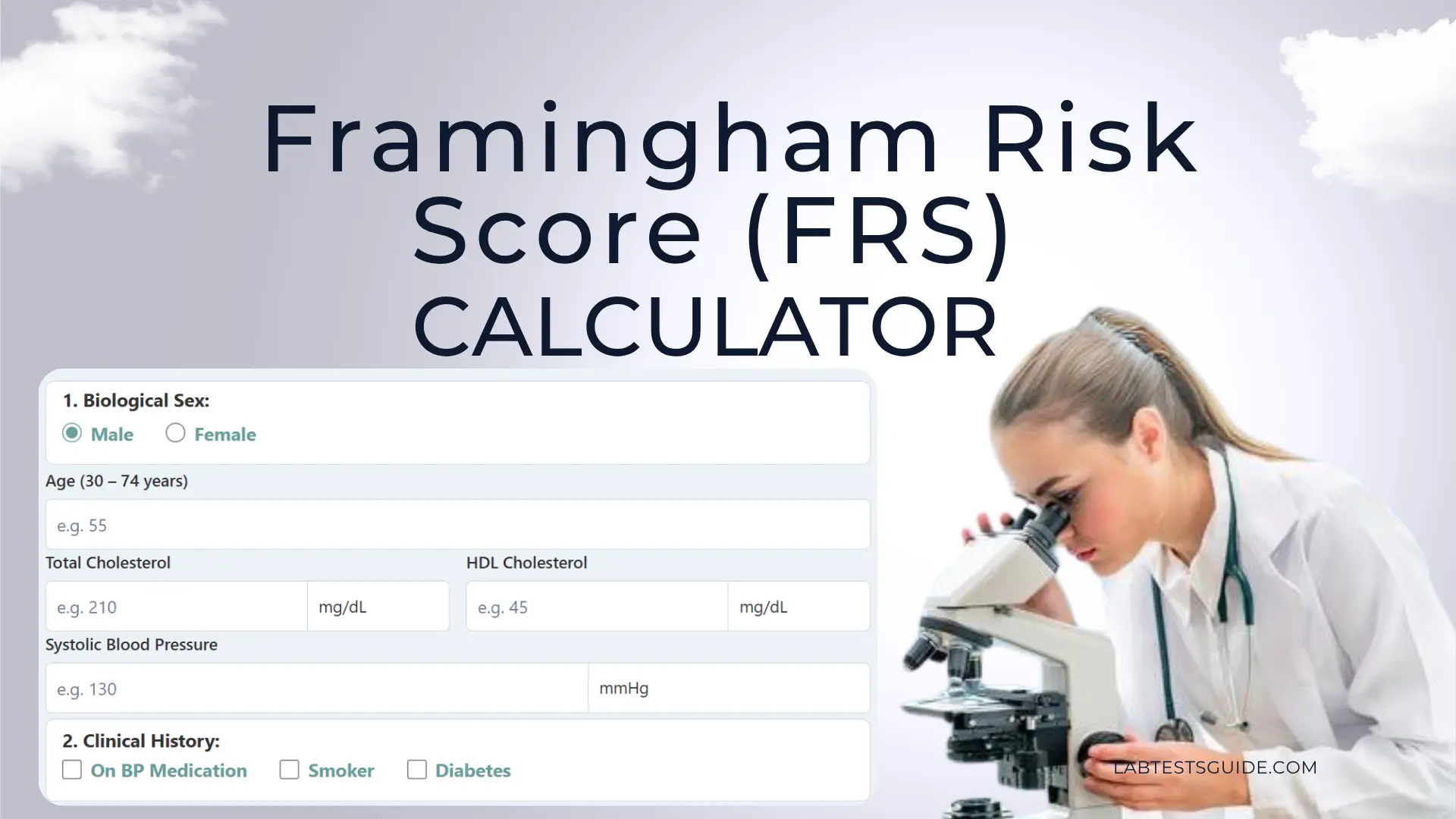
Use our interactive, responsive calculator below. It features a robust Unit Converter handling over 6 different input combinations (mg/dL, mmol/L, mmHg, kPa) to instantly adapt to your specific laboratory formats.
How to Use the Calculator
- Select Demographics: Choose the patient’s biological sex and enter their age. The formula is optimized for adults aged 30 to 74.
- Enter Lab Values: Input Total Cholesterol and HDL. Use the drop-down selectors to switch between
mg/dLormmol/Ldepending on your lab report. - Enter Vitals: Input Systolic Blood Pressure (the top number).
- Select History: Check the boxes if the patient is currently taking blood pressure medication, smokes cigarettes, or has diabetes.
- Instant Results: The calculator updates automatically. No “Calculate” button is needed.
How to Use the Live Unit Converter
Our tool simplifies complex medical data by handling multi-unit conversions in real-time:
- Cholesterol (TC & HDL): Convert between
mg/dL(US standard) andmmol/L(International standard). Note: 1 mmol/L = 38.67 mg/dL. - Blood Pressure: Convert between
mmHgandkPa. Note: 1 kPa = 7.50062 mmHg. - Output Conversion: Use the teal bar at the bottom to convert the standard percentage (e.g., 15%) into a relatable patient ratio (e.g., “1 in 6 chance”).
Formulas Used in This Calculator
This calculator utilizes the 2008 General Cardiovascular Risk Profile equation published by D’Agostino et al. It uses a Cox proportional hazards model taking the natural logarithm (ln) of continuous variables.
The general mathematical framework is:
Risk = 1 - S0(10) ^ exp(Σ(β × ln(Value)) - Mean_Sum)
Male Coefficients (β):
- ln(Age): 3.06117
- ln(Total Cholesterol): 1.12370
- ln(HDL): -0.93263
- ln(SBP Untreated): 1.93303 | ln(SBP Treated): 1.99881
- Smoker (Yes=1): 0.65451
- Diabetes (Yes=1): 0.57367
- Baseline Survival S0(10): 0.88936
Calculation Example (Mathematics)
Let’s look at a mathematical example to understand how the logarithmic formula processes data.
Scenario: A 55-year-old male, non-smoker, no diabetes, untreated SBP of 130 mmHg, Total Cholesterol of 210 mg/dL, and HDL of 45 mg/dL.
1. Take natural logs: ln(55) = 4.007, ln(210) = 5.347, ln(45) = 3.806, ln(130) = 4.867.
2. Multiply by coefficients: (4.007 × 3.06117) + (5.347 × 1.12370) + (3.806 × -0.93263) + (4.867 × 1.93303) = Sum
3. Calculate exponential difference: exp(Sum – 23.9802)
4. Apply baseline survival: 1 – (0.88936 ^ exp_diff)
Final Output: ~16% (Intermediate Risk)
Clinical Interpretation Guidelines
The resulting 10-year risk percentage categorizes patients into three primary tiers, guiding clinical intervention such as statin initiation:
| 10-Year CVD Risk (%) | Risk Tier | General Clinical Recommendation |
|---|---|---|
| < 10% | Low Risk | Maintain a healthy lifestyle. Routine screening every 3-5 years. |
| 10% – 20% | Intermediate Risk | Consider lipid-lowering therapy (statins) depending on other risk modifiers. Intense lifestyle modification. |
| > 20% | High Risk | Strongly consider aggressive lipid-lowering therapy and blood pressure management. |
Disclaimer: This Framingham Risk Score calculator is intended for educational and informational purposes only. It should not replace professional clinical judgment. Always consult current clinical guidelines (e.g., AHA/ACC) and a physician for medical diagnoses and treatment plans.
