

Biochemical Test of Haemophilus aegyptius 50 FAQs and 30 MCQs
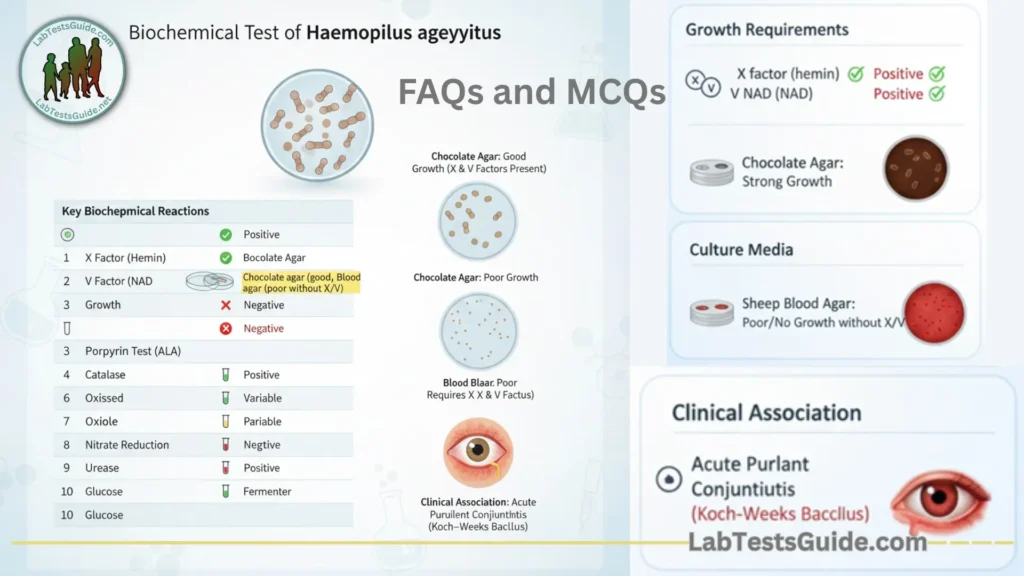
Biochemical Test of Haemophilus aegyptius 50 FAQs
What is Haemophilus aegyptius commonly known as?
Koch-Weeks bacillus.
What disease is Haemophilus aegyptius primarily associated with?
Acute conjunctivitis (pink eye).
What is the Gram stain reaction of Haemophilus aegyptius?
Gram-negative.
What is the shape of Haemophilus aegyptius cells?
Pleomorphic rods or coccobacilli (long slender rods).
Is Haemophilus aegyptius motile?
No, it is non-motile.
Does Haemophilus aegyptius have a capsule?
No, it is capsule-negative.
What is the first step often used in identifying Haemophilus aegyptius?
Gram staining.
What type of media does Haemophilus aegyptius require for growth?
Enriched media.
On which specific enriched agar does Haemophilus aegyptius grow well?
Chocolate agar.
What is the X factor required by Haemophilus aegyptius?
Hemin (a heme derivative).
What is the V factor required by Haemophilus aegyptius?
Nicotinamide adenine dinucleotide (NAD).
What happens on blood agar if H. aegyptius lacks the V factor?
Growth is slow and colonies are small
How long does it typically take for H. aegyptius to grow on culture media?
24-48 hours.
At what temperature is H. aegyptius incubated?
35–37°C.
What atmospheric condition is beneficial for H. aegyptius growth?
Increased CO2.
Is Haemophilus aegyptius catalase positive or negative?
Positive (+ve).
What does a positive catalase test look like?
Formation of bubbles when hydrogen peroxide is added.
Is Haemophilus aegyptius oxidase positive or negative?
Positive (+ve).
What does a positive oxidase test indicate?
Presence of cytochrome c oxidase
What is the purpose of the Satellite test for H. aegyptius?
To demonstrate its requirement for V factor (NAD).
How is the Satellite test performed?
Cultured on blood agar near a streak of Staphylococcus aureus (which produces V factor).
What is a positive result in the Satellite test?
Growth of H. aegyptius colonies (satellites) only near the S. aureus streak.
Is Haemophilus aegyptius able to reduce nitrate?
Yes, it is Nitrate Reduction Positive (+ve).
What does a positive nitrate reduction test typically show?
A red color after adding reagents, indicating nitrite production.
What does it mean if there’s no color change in the nitrate test?
Zinc powder is added; if still no red, nitrate was reduced beyond nitrite (e.g., to gas).
Is Haemophilus aegyptius urease positive or negative?
*source states Positive (+ve); source 2 states Negative.* (Discrepancy noted).
Does Haemophilus aegyptius produce indole?
No, it is Indole Negative (-ve).
What is the purpose of the Porphyrin test for Haemophilus species?
To distinguish them based on their ability to synthesize heme.
What result does H. aegyptius give in the Porphyrin test?
Negative (cannot synthesize heme, requires X factor).
Which carbohydrates does Haemophilus aegyptius ferment to produce acid?
Glucose and Xylose (according to source 1). source 2 also mentions Sucrose and Maltose.
Does Haemophilus aegyptius ferment Adonitol?
No.
Does Haemophilus aegyptius ferment Arabinose?
No.
. Does Haemophilus aegyptius ferment Cellobiose?
No.
Does Haemophilus aegyptius ferment Dulcitol?
No.
Does Haemophilus aegyptius ferment Erythritol?
No.
Does Haemophilus aegyptius ferment Fructose?
No.
Does Haemophilus aegyptius ferment Glycerol?
No.
Does Haemophilus aegyptius ferment Inositol?
No.
Does Haemophilus aegyptius ferment Inulin?
No.
Does Haemophilus aegyptius ferment Lactose?
No.
Does Haemophilus aegyptius ferment Mannitol?
No.
Does Haemophilus aegyptius ferment Mannose?
No.
Does Haemophilus aegyptius ferment Melibiose?
No.
Does Haemophilus aegyptius ferment Raffinose?
No.
Does Haemophilus aegyptius ferment Rhamnose?
No.
Does Haemophilus aegyptius produce gas during fermentation?
No, Gas Negative (-ve).
Is Haemophilus aegyptius positive for Alkaline Phosphatase?
Yes (+ve).
Does Haemophilus aegyptius produce IgA1 protease?
Yes (+ve)
Does Haemophilus aegyptius produce Neuraminidase?
Yes (+ve).
Is Haemophilus aegyptius hemolytic?
No, Hemolysis Negative (-ve).
Biochemical Test of Haemophilus aegyptius 30MCQs
- What is Haemophilus aegyptius commonly known as?
a) Pfeiffer’s bacillus
b) Koch-Weeks bacillus✔
c) Ducrey’s bacillus
d) Friedländer’s bacillus - Which disease is primarily associated with Haemophilus aegyptius?
a) Pneumonia
b) Meningitis
c) Acute conjunctivitis✔
d) Urinary tract infection - What is the Gram stain result for Haemophilus aegyptius?
a) Gram-positive
b) Gram-variable
c) Gram-negative✔
d) Acid-fast - What is the cellular shape of Haemophilus aegyptius?
a) Spherical cocci
b) Long slender rods✔
c) Spiral filaments
d) Club-shaped rods - Which enriched medium is optimal for growing Haemophilus aegyptius?
a) MacConkey agar
b) Sabouraud dextrose agar
c) Chocolate agar✔
d) Mannitol salt agar - What does Haemophilus aegyptius require for growth?
a) X factor only
b) V factor only
c) Both X and V factors✔
d) Neither X nor V factor - The X factor refers to:
a) NAD (nicotinamide adenine dinucleotide)
b) Hemin (a heme derivative)✔
c) Sucrose
d) Tryptophan - The V factor refers to:
a) Hemin
b) NAD✔
c) Glucose
d) Urea - A positive catalase test for H. aegyptius is indicated by:
a) Color change to blue
b) Formation of bubbles✔
c) Red ring formation
d) Fluorescence - The oxidase test result for H. aegyptius is:
a) Positive✔
b) Negative
c) Variable
d) Not applicable - In the satellite test, H. aegyptius grows near Staphylococcus aureus because:
a) S. aureus provides X factor.
b) S. aureus provides V factor (NAD).✔
c) S. aureus neutralizes toxins.
d) S. aureus inhibits competitors. - Which carbohydrate is fermented by H. aegyptius with acid production?
a) Lactose
b) Sucrose
c) Glucose✔
d) Arabinose - Which carbohydrate is NOT fermented by H. aegyptius?
a) Glucose
b) Xylose
c) Lactose✔
d) Mannose - The nitrate reduction test for H. aegyptius is:
a) Positive✔
b) Negative
c) Inconclusive
d) Not required - A positive nitrate reduction test is confirmed by:
a) Formation of bubbles
b) Color change to red✔
c) Blue fluorescence
d) Black precipitate - The urease test result for H. aegyptius (per Article 1) is:
a) Positive✔
b) Negative
c) Weakly positive
d) Not documented - The indole production test for H. aegyptius is:
a) Positive
b) Negative✔
c) Variable
d) Requires tryptophan - The porphyrin test indicates H. aegyptius:
a) Can synthesize heme independently.
b) Cannot synthesize heme (requires X factor).✔
c) Produces porphyrin pigments.
d) Is resistant to UV light. - H. aegyptius is:
a) Motile
b) Non-motile✔
c) Partially motile
d) Motile only at 25°C - Which enzyme is produced by H. aegyptius?
a) Arginine dihydrolase
b) β-galactosidase (ONPG)
c) IgA1 protease✔
d) Urease - The alkaline phosphatase test result for H. aegyptius is:
a) Positive✔
b) Negative
c) Variable
d) Not tested - H. aegyptius shows:
a) Alpha-hemolysis
b) Beta-hemolysis
c) Gamma-hemolysis (non-hemolytic)✔
d) Delayed hemolysis - The capsule stain result for H. aegyptius is:
a) Positive
b) Negative
c) Variable✔
d) Not mentioned - The arginine dihydrolase test result for H. aegyptius is:
a) Positive
b) Negative✔
c) Weakly positive
d) Requires decarboxylation - Neuraminidase production in H. aegyptius is:
a) Positive✔
b) Negative
c) Strain-dependent
d) Not tested - The optimal incubation temperature for H. aegyptius is:
a) 25–30°C
b) 35–37°C✔
c) 42°C
d) 50°C - Growth of H. aegyptius is enhanced by:
a) High oxygen
b) Increased CO₂✔
c) Anaerobic conditions
d) Low pH - The fucosidase test result for H. aegyptius is:
a) Positive
b) Negative✔
c) Equivocal
d) Not applicable - Which test helps differentiate Haemophilus species based on heme synthesis?
a) Catalase test
b) Porphyrin test✔
c) Indole test
d) Oxidase test - Colonies of H. aegyptius on blood agar without adequate V factor appear:
a) Large and pigmented
b) Swarming
c) Small and slow-growing✔
d) Beta-hemolytic
