

Hektoen Enteric Agar 50 FAQs and 30 MCQs
Hektoen Enteric (HE) Agar is a selective and differential culture medium widely used in clinical microbiology for the isolation and differentiation of enteric pathogens, particularly Salmonella and Shigella species, from stool and other clinical specimens. It contains bile salts to inhibit Gram-positive bacteria and lactose, sucrose, and salicin as fermentable carbohydrates to differentiate organisms based on their metabolic activity.
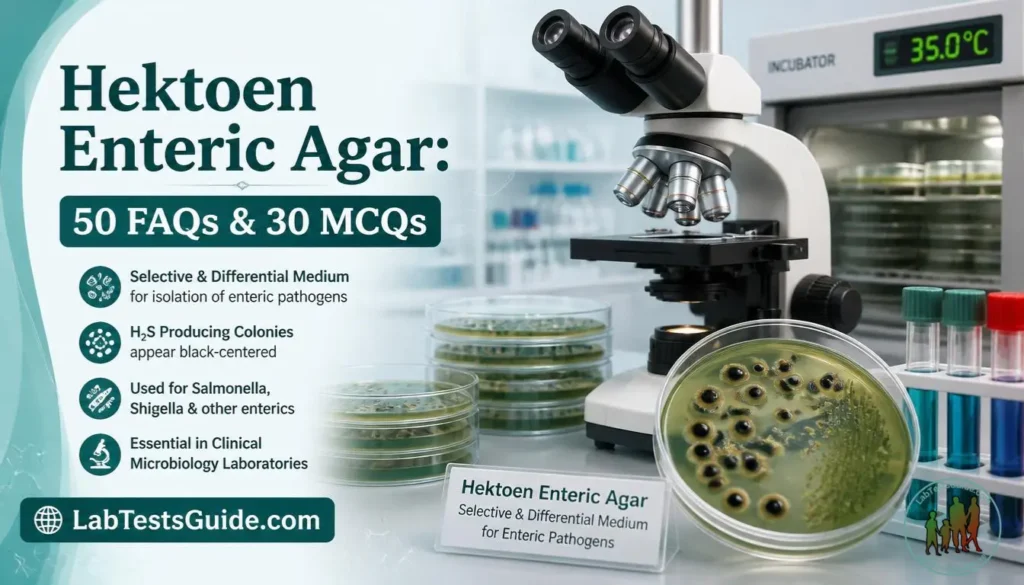
Hektoen Enteric Agar also includes indicators such as bromothymol blue and acid fuchsin, along with ferric ammonium citrate to detect hydrogen sulfide (H₂S) production, which helps in identifying characteristic black-centered colonies of Salmonella species.
This article provides a complete set of 50 FAQs and 30 MCQs designed to strengthen your understanding of Hektoen Enteric Agar, including its composition, principle, preparation, interpretation, and clinical applications in microbiology.
Hektoen Enteric Agar (HE Agar) 50 FAQs
What is Hektoen Enteric Agar (HE Agar) used for?
HE Agar is a selective and differential medium for isolating and differentiating Salmonella and Shigella from other Enterobacteriaceae in clinical, food, and environmental samples.
Who developed HE Agar, and when?
Sylvia King and William I. Metzger developed it in 1968 at the Hektoen Institute in Chicago.
How does HE Agar compare to MacConkey or EMB agar?
HE Agar is more selective due to higher bile salt concentrations and uses dual indicators (bromothymol blue, acid fuchsin) for better differentiation, unlike MacConkey/EMB, which rely on lactose fermentation alone.
Why is HE Agar considered both selective and differential?
Bile salts inhibit gram-positive and some gram-negative bacteria (selective), while carbohydrate fermentation and H₂S production indicators differentiate pathogens (differential).
What are the key components of HE Agar?
Key ingredients include bile salts, lactose/sucrose/salicin, bromothymol blue, acid fuchsin, sodium thiosulfate, and ferric ammonium citrate.
Why are bile salts included?
They inhibit gram-positive bacteria and some non-pathogenic gram-negative bacteria, enhancing pathogen recovery.
Why shouldn’t HE Agar be autoclaved?
Overheating degrades bile salts and indicators; it is dissolved by boiling instead.
What is the pH of HE Agar, and why is it important?
pH 7.5±0.2 optimizes pathogen growth and indicator performance.
What role do sodium thiosulfate and ferric ammonium citrate play?
They detect H₂S production (black precipitate in colonies).
How does HE Agar differentiate Salmonella and Shigella?
Salmonella forms blue-green colonies with black centers (H₂S+), while Shigella appears green without H₂S. Non-pathogens show orange/salmon colonies.
What do colony colors indicate?
Blue-green/black: Salmonella (H₂S+).
Green: Shigella.
Orange/salmon: Lactose/sucrose/salicin fermenters (e.g., E. coli).How does H₂S production affect colony appearance?
Reacts with ferric ammonium citrate, forming black precipitates in colonies (e.g., Salmonella).
Why are Proteus species a concern?
They may resemble Salmonella (H₂S+), but are often smaller and may ferment carbohydrates
What happens if HE Agar is incubated beyond 24 hours?
Extended incubation can deplete carbohydrates, leading to alkaline byproducts and false-negative fermentation results.
What historical developments led to HE Agar?
Earlier media like Endo agar (1903), MacConkey agar (1905), and EMB agar (1916) inspired HE Agar’s selective and differential improvements.
How did HE Agar improve upon Salmonella-Shigella Agar?
HE Agar’s enriched peptones and reduced dye toxicity improved Shigella recovery, which earlier media overly inhibited.
Why were dyes like brilliant green used historically?
They inhibited non-pathogens but were later replaced in HE Agar with less toxic bromothymol blue and acid fuchsin.
Can HE Agar be used alone for diagnosis?
No—it’s a screening tool; biochemical/serological confirmation is required.
What are HE Agar’s limitations?
May miss slow-growing Shigella.
Proteus can mimic Salmonella.
Requires additional media for comprehensive pathogen recovery.What specimens are suitable for HE Agar?
Feces, rectal swabs, food, water, or enrichment broths (e.g., selenite broth).
How does HE Agar inhibit non-pathogens?
High bile salts and dyes suppress lactose/sucrose fermenters, while pathogens tolerate these inhibitors.
What QC organisms are used for HE Agar?
ATCC strains like E. coli (orange colonies), Salmonella (blue-green/black), and Shigella (green).
How should HE Agar plates be stored?
At 4–8°C in plastic to prevent dehydration; stable for ~70 days.
How does HE Agar’s selectivity compare to older media?
More selective than MacConkey/EMB due to higher bile salts and dual indicators.
What role did peptones play in HE Agar’s design?
Enriched peptones offset bile salt inhibition, improving Shigella recovery.
Why are multiple media recommended for enteric pathogens?
No single medium recovers all pathogens; a combination increases detection accuracy.
What carbohydrates are in HE Agar?
Lactose, sucrose, and salicin—fermented by non-pathogens to produce acid (orange colonies).
Why do bile salts precipitate around colonies?
Acid from carbohydrate fermentation interacts with bile salts, creating hazy zones.
How do gram-positive bacteria react to HE Agar?
They are inhibited by bile salts and dyes.
What confirmatory tests follow HE Agar?
Biochemical tests (TSI, urea, API kits) and serological typing.
What environmental factors affect HE Agar?
CO₂ incubation alters pH; aerobic conditions at 35–37°C are ideal.
How does HE Agar handle lactose-fermenting Salmonella?
Rare strains may appear orange with black centers but require confirmation.
How did Endo agar differ from HE Agar?
Endo agar’s lactose fermentation color change occurred in the media, not colonies, making differentiation harder.
What role did Alfred MacConkey play?
Introduced bile salts and neutral red in MacConkey agar to inhibit gram-positive bacteria and differentiate lactose fermenters.
Why was EMB agar significant?
It differentiated E. coli (metallic green) from other Enterobacteriaceae using eosin and methylene blue.
How did brilliant green agar contribute?
It enhanced Salmonella recovery by inhibiting coliforms but was too harsh for Shigella.
What prompted the development of HE Agar?
The need for a medium that better recovered Shigella and reduced false negatives from over-inhibition.
What do yellow-orange colonies indicate?
Lactose/sucrose/salicin fermentation by non-pathogens (e.g., E. coli).
Why might Enterobacter/Klebsiella appear salmon-colored?
They ferment salicin but are typically non-pathogenic.
How do Citrobacter species appear?
They may produce H₂S (black centers) but ferment carbohydrates (orange/salmon).
How is HE Agar inoculated?
Streaked directly from fecal samples, swabs, or enrichment broths for isolated colonies.
What incubation conditions are optimal?
18–24 hours at 35–37°C aerobically; extended incubation improves Shigella differentiation.
How does HE Agar’s formulation reduce inhibition of Shigella?
Increased peptones and carbohydrates counterbalance bile salt effects.
What modifications exist for HE Agar?
Commercial variants may adjust bile salt or carbohydrate concentrations for specific use cases.
How has HE Agar evolved since 1968?
Quality control standards and preparation protocols have been refined, but the original formula remains largely unchanged.
Why might Shigella show weak growth?
Some strains require 48 hours of incubation for visibility.
What causes false-negative fermentation results?
Over-incubation leading to alkaline byproducts from protein metabolism.
How does HE Agar improve on XLD agar?
HE Agar better inhibits Proteus and differentiates Shigella, whereas XLD focuses on Salmonella.
Why is HE Agar preferred for food testing?
Its selectivity and differential capacity suit diverse samples with mixed flora.
How do HE Agar’s indicators compare to earlier media?
Bromothymol blue and acid fuchsin are less toxic than eosin/methylene blue, improving pathogen recovery.
Hektoen Enteric Agar 30 MCQs
Q1. What is the primary purpose of HE Agar?
A) To grow gram-positive bacteria
B) To isolate and differentiate Salmonella and Shigella✔
C) To identify viral pathogens
D) To culture anaerobic bacteria
Q2. Who developed HE Agar?
A) Alfred MacConkey
B) Sylvia King and William Metzger✔
C) Robert Koch
D) Louis Pasteur
Q3. HE Agar is considered:
A) Only selective
B) Only differential
C) Both selective and differential✔
D) A non-selective medium
Q4. Which ingredient in HE Agar detects H₂S production?
A) Bromothymol blue
B) Ferric ammonium citrate✔
C) Bile salts
D) Lactose
Q5. Why should HE Agar not be autoclaved?
A) It solidifies too quickly
B) Autoclaving degrades bile salts and indicators✔
C) It becomes too acidic
D) Autoclaving promotes contamination
Q6. Salmonella colonies on HE Agar typically appear:
A) Orange with black centers
B) Blue-green with black centers✔
C) Metallic green
D) Bright pink
Q7. Shigella colonies on HE Agar are usually:
A) Green and transparent✔
B) Orange with bile precipitation
C) Black-centered
D) Yellow
Q8. Lactose-fermenting bacteria like E. coli produce colonies that are:
A) Blue-green
B) Orange to salmon pink✔
C) Colorless
D) Red
Q9. What does a black precipitate in colonies indicate?
A) Lactose fermentation
B) H₂S production✔
C) Gram-positive contamination
D) Bile salt inhibition
Q10. Which organism may resemble Salmonella on HE Agar due to H₂S production?
A) E. coli
B) Proteus✔
C) Streptococcus
D) Staphylococcus
Q11. Which medium was the first selective agar for enteric pathogens?
A) MacConkey Agar
B) Endo Agar✔
C) EMB Agar
D) HE Agar
Q12. MacConkey Agar uses which inhibitor?
A) Bile salts✔
B) Brilliant green dye
C) Sodium chloride
D) Acid fuchsin
Q13. What problem did EMB Agar solve compared to Endo Agar?
A) Inhibition of gram-positive bacteria
B) Colony-based color change for lactose fermentation✔
C) Detection of H₂S
D) Growth of anaerobes
Q14. Why was HE Agar developed?
A) To replace all previous media
B) To improve recovery of Shigella✔
C) To inhibit Salmonella
D) To detect viral pathogens
Q15. Which historical medium used brilliant green dye for selectivity?
A) XLD Agar
B) Salmonella-Shigella Agar
C) Brilliant Green Agar✔
D) EMB Agar
Q16. Bile salts in HE Agar primarily:
A) Promote gram-positive growth
B) Inhibit non-pathogenic gram-negative bacteria✔
C) Enhance lactose fermentation
D) Detect H₂S
Q17. Which carbohydrate is not present in HE Agar?
A) Lactose
B) Sucrose
C) Glucose✔
D) Salicin
Q18. Bromothymol blue in HE Agar acts as a:
A) pH indicator✔
B) Growth enhancer
C) Inhibitor
D) Carbohydrate source
Q19. What is the role of peptones in HE Agar?
A) Offset bile salt inhibition✔
B) Detect H₂S
C) Inhibit gram-positive bacteria
D) Enhance lactose fermentation
Q20. The pH of HE Agar is:
A) 6.5
B) 7.5✔
C) 8.5
D) 5.5
Q21. A key limitation of HE Agar is:
A) It cannot differentiate Salmonella and Shigella
B) It may miss some Shigella strains requiring longer incubation✔
C) It kills all gram-negative bacteria
D) It cannot detect H₂S
Q22. Why must biochemical tests follow HE Agar screening?
A) To confirm pathogen identity✔
B) To enhance colony color
C) To inhibit non-pathogens
D) To reduce incubation time
Q23. Over-incubation of HE Agar may lead to:
A) False-positive lactose fermentation
B) False-negative lactose fermentation✔
C) Enhanced H₂S production
D) Bile salt precipitation
Q24. Which specimen is not suitable for HE Agar?
A) Feces
B) Blood cultures✔
C) Food samples
D) Rectal swabs
Q25. HE Agar should be incubated:
A) Anaerobically
B) In CO₂
C) Aerobically at 35–37°C✔
D) At room temperature
Q26. Which organism is used for HE Agar quality control?
A) Salmonella Typhimurium✔
B) Staphylococcus aureus
C) Candida albicans
D) Pseudomonas aeruginosa
Q27. Which medium preceded HE Agar but overly inhibited Shigella?
A) XLD Agar
B) Salmonella-Shigella Agar✔
C) EMB Agar
D) MacConkey Agar
Q28. What differentiates HE Agar from MacConkey Agar?
A) Use of bile salts
B) Dual carbohydrate indicators
C) Inclusion of H₂S detection
D) Both B and C✔
Q29. Which component in HE Agar precipitates due to acid production?
A) Ferric ammonium citrate
B) Bile salts✔
C) Bromothymol blue
D) Sodium thiosulfate
Q30. HE Agar is recommended by which pharmacopeia for Salmonella testing?
A) European Pharmacopoeia
B) United States Pharmacopoeia✔
C) Indian Pharmacopoeia
D) British Pharmacopoeia
Hektoen Enteric Agar is an essential selective and differential medium used for the isolation and identification of intestinal pathogens. Its ability to differentiate lactose fermenters from non-fermenters, along with detection of hydrogen sulfide production, makes it highly valuable in clinical diagnostic laboratories.
A strong understanding of HE Agar is crucial for microbiology students, laboratory technologists, and healthcare professionals involved in stool culture and enteric pathogen identification. The FAQs and MCQs provided in this article serve as a reliable resource for revision, exam preparation, and laboratory practice.
