

Martin Lewis Agar 50 FAQs and 30 MCQs:
Martin Lewis Agar is a selective and enriched culture medium primarily used for the isolation of pathogenic Neisseria species, particularly Neisseria gonorrhoeae and Neisseria meningitidis, from clinical specimens containing mixed microbial flora. The medium is based on chocolate agar and contains antimicrobial agents that suppress the growth of contaminating bacteria and fungi while allowing pathogenic Neisseria species to grow.
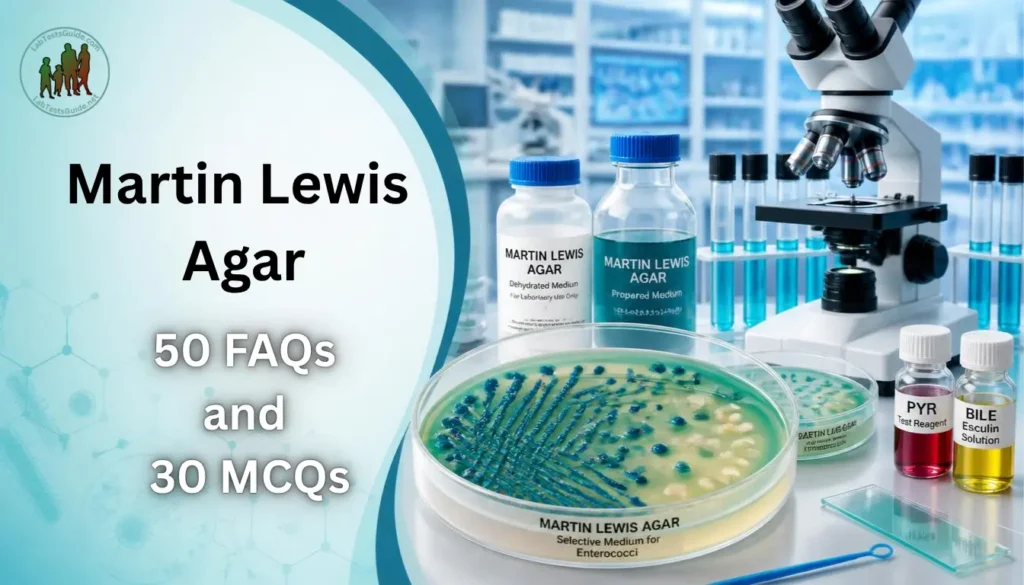
Due to its high selectivity and reliability, Martin Lewis Agar is widely used in clinical microbiology laboratories for the diagnosis of gonococcal and meningococcal infections. Understanding its composition, principle, preparation, quality control, and clinical applications is essential for students and laboratory professionals.
This article provides a comprehensive collection of FAQs and MCQs covering all important aspects of Martin Lewis Agar to support learning, examination preparation, and practical laboratory training.
Martin Lewis Agar 30 FAQs:
What is the primary purpose of Martin Lewis Agar?
To selectively isolate pathogenic Neisseria species (e.g., N. gonorrhoeae and N. meningitidis) from mixed microbial flora.
How does Martin Lewis Agar differ from Thayer-Martin Agar?
It contains higher vancomycin levels to better inhibit gram-positive bacteria and improve Neisseria recovery.
Which pathogens are targeted by Martin Lewis Agar?
Neisseria gonorrhoeae (gonorrhea) and Neisseria meningitidis (meningitis).
Why was Martin Lewis Agar developed?
To enhance selective inhibition of contaminants while improving recovery of fastidious Neisseria species.
What key antibiotics are in Martin Lewis Agar?
Vancomycin (gram-positive inhibition), colistin (gram-negative inhibition), anisomycin (fungi), and trimethoprim (Proteus).
What role does hemoglobin play in the medium?
It supplies the X factor (heme) required for Neisseria growth.
What is the function of Bio-X enrichment?
Provides the V factor (NAD), vitamins, amino acids, and coenzymes for Neisseria growth.
Which component neutralizes toxic fatty acids in the agar?
Corn starch.
What is the pH of Martin Lewis Agar?
7.2 ± 0.2 at 25°C.
What distinguishes Hardy Diagnostics’ Martin Lewis with Lincomycin?
Reduced vancomycin, added lincomycin, and CO₂ tablets for improved oropharyngeal specimen recovery.
Why is the agar cooled to 45–50°C before adding blood/enrichments?
To avoid denaturing heat-sensitive components like antibiotics and hemoglobin.
How is CO₂ generated in Hardy’s Martin Lewis Agar?
Via a sodium bicarbonate and citric acid tablet activated by moisture in a sealed ziplock bag.
What sterilization method is used for the agar base?
Autoclaving at 121°C for 15 minutes.
How should prepared Martin Lewis Agar be stored?
At 2–8°C, protected from light, and used within 60 days.
What indicates deteriorated media?
Shrinking, cracking, discoloration, or contamination.
How does Martin Lewis Agar selectively inhibit contaminants?
Antibiotics suppress gram-positive bacteria, gram-negative bacilli, fungi, and Proteus.
Why can’t Haemophilus influenzae grow on this medium?
It requires both X and V factors, but NADase in sheep blood degrades the V factor.
What makes Martin Lewis Agar an enriched medium?
Bio-X enrichment (NAD, vitamins) and hemoglobin support fastidious Neisseria growth.
How does lincomycin enhance recovery of N. gonorrhoeae?
It reduces vancomycin’s inhibitory effects on some Neisseria strains.
Which specimens are cultured on Martin Lewis Agar?
Genital, oropharyngeal, rectal, and urethral swabs with mixed flora.
Why is it used alongside non-selective media?
To ensure recovery of pathogens potentially inhibited by antibiotics in selective media.
What diagnostic tests follow isolation on this agar?
Oxidase testing, Gram staining, biochemical tests, and PCR.
How does it aid in epidemiological studies?
Standardizes isolation of Neisseria for antibiotic resistance tracking and strain analysis.
Describe N. gonorrhoeae colonies on Martin Lewis Agar.
Small, grayish-white, mucoid colonies with smooth or rough texture
How do N. meningitidis colonies appear?
Medium to large, blue-gray, mucoid colonies.
What indicates a false-positive result?
Oxidase-positive gram-negative bacilli mimicking Neisseria colonies.
Why might some N. gonorrhoeae strains fail to grow?
Sensitivity to vancomycin or trimethoprim in the medium.
What factors affect Neisseria recovery in cultures?
Improper specimen handling, prior antibiotics, or incorrect incubation (temperature/CO₂).
Why is confirmatory testing necessary?
Non-pathogenic Neisseria (e.g., N. sicca) may resemble target colonies.
Which organisms are used for QC testing?
N. gonorrhoeae (ATCC 43069), N. meningitidis (ATCC 13090), E. coli (ATCC 25922), and Candida albicans (ATCC 60193).
What pH range is acceptable for the agar?
6.80–7.20 in a 4.2% aqueous solution.
How is gelling quality assessed?
By forming a firm gel equivalent to a 1.3% agar solution.
What is unique about Martin Lewis with Lincomycin?
Contains lincomycin, amphotericin B, and CO₂ tablets for enhanced oropharyngeal specimen recovery.
How is the CO₂ environment maintained in Hardy’s plates?
A sealed ziplock bag with a moisture-activated CO₂-generating tablet.
What is the incubation protocol for Hardy’s variant?
*35°C for 24–72 hours in a CO₂-enriched atmosphere.*
How did Thayer-Martin evolve into Martin Lewis Agar?
Increased vancomycin and modified antibiotics for better selectivity.
Why is Martin Lewis preferred over Thayer-Martin?
Higher Neisseria recovery due to optimized antibiotic concentrations.
What precautions are needed when handling the agar?
Use universal precautions (gloves, lab coat), autoclave waste, and avoid skin contact.
Why is the medium considered a biohazard?
Clinical specimens may contain pathogens like HIV or hepatitis viruses.
Why are phosphate buffers included?
To maintain pH stability during bacterial growth.
How does dextrose support microbial growth?
Serves as a fermentable carbohydrate energy source.
What role does L-cysteine play in Bio-X enrichment?
Acts as a reducing agent to support anaerobic growth conditions.
What causes poor hemolysis visibility?
High starch content or improper blood incorporation.
Why might Proteus species still grow?
Trimethoprim resistance in some strains.
How to address excessive moisture on plates?
Air-dry plates briefly before incubation to prevent condensation.
How is Martin Lewis Agar used in research?
To study Neisseria antibiotic resistance, virulence, and genetic diversity.
Can it detect penicillinase-producing N. gonorrhoeae?
Yes, when supplemented with penicillin G in specific formulations.
How should inoculated plates be transported?
At ambient temperature (15–30°C), protected from extremes, and incubated promptly.
What is the shelf life of dehydrated media?
Stored below 30°C in a sealed container, it remains stable until the expiration date.
Why is IsoVitaleX enrichment used?
To replace Bio-X and provide essential growth factors (e.g., NAD, vitamins) for Neisseria.
Martin Lewis Agar 30 MCQs
- What is the primary purpose of Martin Lewis Agar?
a) Culturing fungi
b) Isolating Neisseria species✔
c) Growing anaerobic bacteria
d) Detecting viral infections - Which antibiotic in Martin Lewis Agar inhibits gram-positive bacteria?
a) Colistin
b) Vancomycin✔
c) Anisomycin
d) Trimethoprim - How do colonies of Neisseria gonorrhoeae appear on Martin Lewis Agar?
a) Large blue-gray colonies
b) Small grayish-white mucoid colonies✔
c) Yellow pigmented colonies
d) Translucent with green hemolysis - What temperature should the agar base be cooled to before adding hemoglobin and antibiotics?
a) 25°C
b) 37°C
c) 45–50°C✔
d) 70°C - Which organism is NOT inhibited by Martin Lewis Agar?
a) Proteus species
b) Candida albicans
c) Neisseria gonorrhoeae✔
d) Staphylococcus epidermidis - How does Martin Lewis Agar differ from Thayer-Martin Agar?
a) Contains lower vancomycin
b) Uses human blood instead of sheep blood
c) Higher vancomycin to inhibit gram-positive bacteria✔
d) Lacks antibiotics - What addition in Hardy’s Martin Lewis Agar aids recovery of oropharyngeal Neisseria?
a) Lincomycin and CO₂ tablets✔
b) Penicillin
c) Higher starch content
d) Bovine serum - Which organism is used for QC of Martin Lewis Agar?
a) Escherichia coli ATCC 25922✔
b) Streptococcus pyogenes
c) Lactobacillus acidophilus
d) Mycobacterium tuberculosis - Which component provides the X factor in Martin Lewis Agar?
a) Dextrose
b) Hemoglobin✔
c) Bio-X enrichment
d) Vancomycin - How should prepared Martin Lewis Agar plates be stored?
a) Frozen at -20°C
b) At room temperature in light
c) Refrigerated at 2–8°C✔
d) In a desiccator - Which component supplies the V factor (NAD) in Martin Lewis Agar?
a) Hemoglobin
b) Bio-X enrichment✔
c) Vancomycin
d) Corn starch - Which antibiotic in Martin Lewis Agar targets fungi?
a) Vancomycin
b) Colistin
c) Anisomycin✔
d) Trimethoprim - What is the sterilization method for the agar base?
a) Filtration
b) Boiling for 30 minutes
c) Autoclaving at 121°C for 15 minutes✔
d) UV radiation - Why might some Neisseria gonorrhoeae strains not grow on Martin Lewis Agar?
a) Lack of X factor
b) Inhibition by vancomycin✔
c) Absence of dextrose
d) High pH - How do Neisseria meningitidis colonies appear on Martin Lewis Agar?
a) Small and white
b) Blue-gray and mucoid✔
c) Yellow and opaque
d) Red and dry - How is CO₂ generated in Hardy’s Martin Lewis Agar?
a) Candle jar
b) Sodium bicarbonate and citric acid tablet✔
c) GasPak system
d) Incubator settings - Which Neisseria species is used for QC of Martin Lewis Agar?
a) N. sicca
b) N. gonorrhoeae ATCC 43069✔
c) N. lactamica
d) N. subflava - What is the role of lincomycin in Hardy’s variant?
a) Inhibit gram-negative bacteria
b) Replace vancomycin to reduce inhibition✔
c) Enhance fungal growth
d) Provide V factor - How should dehydrated Martin Lewis Agar be stored?
a) In a freezer
b) Below 30°C in a sealed container✔
c) Exposed to light
d) At room temperature in open air - Which component in Bio-X provides ferric ions?
a) L-glutamine
b) Ferric nitrate✔
c) Adenine
d) Dextrose - Which antibiotic in Martin Lewis Agar inhibits Proteus species?
a) Trimethoprim✔
b) Colistin
c) Vancomycin
d) Anisomycin - What color is prepared Martin Lewis Agar?
a) Red
b) Green
c) Chocolate-colored opaque✔
d) Transparent - What is the role of corn starch in the agar?
a) Nutrient source
b) Neutralize toxic fatty acids✔
c) Indicator of pH
d) Inhibit gram-positives - What atmosphere is required for incubating Martin Lewis Agar?
a) Anaerobic
b) 5-10% CO₂✔
c) Microaerophilic
d) Ambient air - After isolation on Martin Lewis Agar, what test is typically performed first?
a) Gram stain
b) Oxidase test✔
c) Catalase test
d) Coagulase test - What maintains the pH in Martin Lewis Agar?
a) Phosphate buffer✔
b) Sodium chloride
c) Dextrose
d) Hemoglobin - Which antibiotic was added to Thayer-Martin Agar but not Martin Lewis?
a) Nystatin✔
b) Vancomycin
c) Colistin
d) Anisomycin - What does L-cysteine in Bio-X enrichment provide?
a) Carbohydrate source
b) Reducing agent✔
c) Vitamin B12
d) Iron ions - How should inoculated plates be transported?
a) Frozen
b) At 2-8°C
c) Ambient temperature (15-30°C)✔
d) Heated to 37°C - Which organism’s swarming is inhibited on Martin Lewis Agar?
a) Proteus mirabilis✔
b) Escherichia coli
c) Candida albicans
d) Staphylococcus aureus
Martin Lewis Agar remains an important selective medium for the recovery and identification of pathogenic Neisseria species from specimens containing normal microbial flora. Its antimicrobial supplements enhance the isolation of clinically significant organisms while minimizing contamination from unwanted microorganisms.
A thorough understanding of Martin Lewis Agar is valuable for microbiology students, laboratory technologists, and healthcare professionals involved in infectious disease diagnosis. The FAQs and MCQs in this article serve as an effective resource for strengthening both theoretical knowledge and practical laboratory skills.
