

Buffered Charcoal Yeast Extract Agar (BCYE) 50 FAQs and 30 MCQS
Buffered Charcoal Yeast Extract (BCYE) Agar is a highly specialized enriched culture medium widely used in clinical microbiology for the isolation and cultivation of fastidious organisms, especially Legionella pneumophila. It provides essential nutrients, growth factors, and a supportive environment that many bacteria cannot obtain from routine culture media.
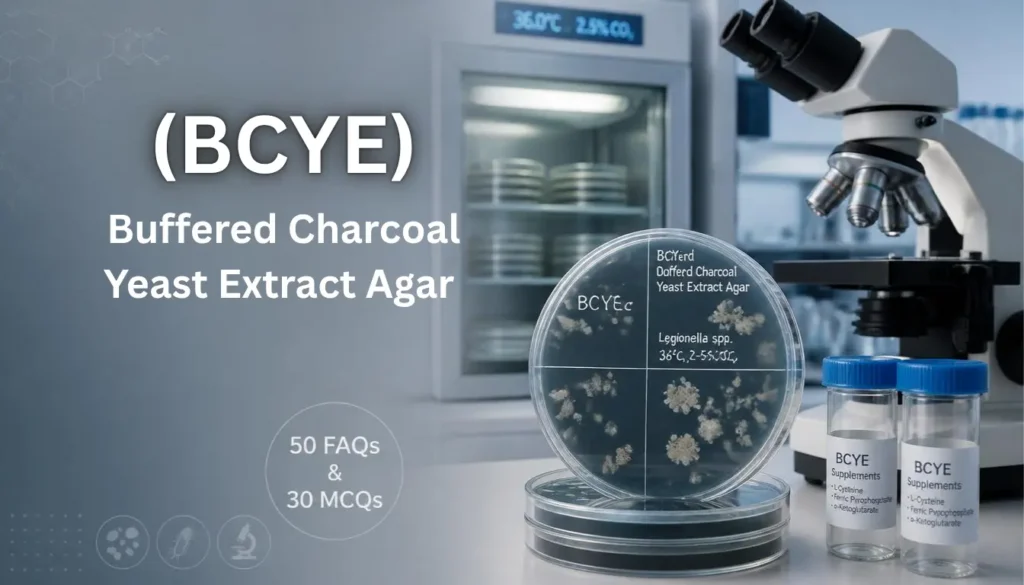
BCYE agar contains activated charcoal, yeast extract, and buffering agents that help neutralize toxic metabolites and supply essential nutrients required for bacterial growth. It is considered the gold standard medium for isolating Legionella species from environmental and clinical specimens such as water samples, respiratory secretions, and tissue biopsies.
This article presents comprehensive FAQs and MCQs designed to strengthen your understanding of BCYE agar, including its composition, principle, preparation, applications, and microbiological significance in diagnostic laboratories.
Buffered Charcoal Yeast Extract Agar (BCYE) 50 FAQs
What is BCYE Agar?
A specialized medium for isolating Legionella species.
What does BCYE stand for?
Buffered Charcoal Yeast Extract.
Why is BCYE Agar used?
To cultivate and isolate Legionella from clinical and environmental samples.
Who developed BCYE Agar?
Initially by Feeley et al., then modified by Pasculle and Edelstein.
What modifications were made to BCYE Agar?
Addition of ACES buffer (Pasculle, 1980) and α-ketoglutarate (Edelstein, 1981).
What are the key components of BCYE Agar?
Yeast extract, ACES buffer, activated charcoal, L-cysteine, ferric pyrophosphate, and α-ketoglutarate.
What is the role of yeast extract in BCYE Agar?
Provides nitrogen, carbon, and vitamins for bacterial growth.
Why is activated charcoal added?
Absorbs toxins (like hydrogen peroxide) and modifies surface tension.
What is the function of ACES buffer?
Maintains optimal pH (~6.9) for Legionella growth.
Why is L-cysteine essential in BCYE Agar?
Required for Legionella metabolism; it cannot grow without it.
What does ferric pyrophosphate do?
Supplies iron, which is necessary for Legionella growth.
How does α-ketoglutarate help?
Enhances Legionella recovery by stimulating oxygen-scavenging enzymes.
What is the final pH of BCYE Agar?
6.9 ± 0.2 at 25°C.
How is BCYE Agar prepared?
Dissolved in water, autoclaved, and supplemented with L-cysteine and ferric pyrophosphate.
Can BCYE Agar be made selective?
Yes, by adding antibiotics (e.g., polymyxin B, vancomycin, cycloheximide).
What type of bacteria does BCYE Agar isolate?
Primarily Legionella species.
Why won’t Legionella grow on blood agar?
It lacks L-cysteine and iron, which are essential for Legionella.
How do Legionella colonies appear on BCYE Agar?
Small to large, smooth, pale blue-grey, sometimes mucoid or “fried egg” appearance.
Do Legionella colonies fluoresce?
Some strains (e.g., L. pneumophila) show yellow-green fluorescence under UV light.
How long does it take for Legionella to grow?
Typically 3–5 days at 35–37°C in a humid environment.
What are common Legionella species tested on BCYE?
L. pneumophila, L. bozemanae, L. micdadei, L. dumoffii.
Can other bacteria grow on BCYE Agar?
Some (e.g., E. coli, S. aureus) may show limited growth unless selective agents are added.
What is the “fried egg” colony morphology?
A characteristic appearance of some Legionella strains under a microscope.
What supplements are added to make BCYE selective?
Polymyxin B, glycine, vancomycin, anisomycin, cycloheximide.
What is MWY Selective Agar?
A variant of BCYE with added antibiotics for better selectivity.
What is GVPC Selective Agar?
Contains glycine, vancomycin, polymyxin B, and cycloheximide.
What is GVPN Selective Agar?
Similar to GVPC but with natamycin instead of cycloheximide.
Why are antibiotics added to BCYE Agar?
To inhibit non-Legionella bacteria and fungi.
What is the role of polymyxin B in selective BCYE?
Inhibits Gram-negative bacteria.
Why is cycloheximide added?
Prevents fungal contamination.
What QC organisms are used for BCYE Agar?
L. pneumophila (ATCC 33152), E. coli (ATCC 25922), S. aureus (ATCC 25923).
What are the limitations of BCYE Agar?
Some Legionella strains may grow poorly; additional tests (PCR, serology) may be needed.
Why is CO₂ incubation sometimes used?
Enhances growth of L. gormanii but is not required for most species.
Can BCYE Agar be stored?
Prepared plates should be stored at 2–8°C, protected from light.
How long can BCYE Agar be stored?
Dehydrated powder: up to expiration date; prepared plates: typically 1–2 weeks.
What samples is BCYE Agar used for?
Sputum, lung tissue, water (cooling towers, plumbing systems).
Why is BCYE used for water testing?
Legionella thrives in water systems, posing infection risks.
What safety precautions are needed when handling Legionella?
Avoid aerosol formation (risk of inhalation infection).
Does BCYE Agar diagnose Legionnaires’ disease?
It isolates Legionella, but further tests (PCR, urinary antigen) confirm infection.
What alternatives exist if BCYE fails to grow Legionella?
Alternative media (e.g., Wadowsky-Yee agar) or PCR testing.
Why might Legionella not grow on BCYE?
Improper pH, missing supplements, or overgrowth of contaminants.
How can contamination be prevented?
Use selective supplements and proper aseptic techniques.
What if colonies don’t fluoresce?
Some Legionella strains (e.g., L. micdadei) fluoresce blue-white, not yellow-green.
Should BCYE be used alone for Legionella detection?
No, parallel use of selective and non-selective BCYE is recommended.
What incubation conditions are best?
35–37°C, high humidity, up to 10 days for slow-growing strains.
When was BCYE Agar first developed?
Original CYE by Feeley (1978), BCYE by Pasculle (1980).
Is BCYE Agar CDC-approved?
CDC recommends it for Legionella isolation, often with CO₂ for environmental samples.
What standard methods recommend BCYE?
Standard Methods for the Examination of Water and Wastewater.
What is the difference between CYE and BCYE?
BCYE has ACES buffer for pH stability; CYE does not.
Can BCYE Agar detect non-pneumophila Legionella?
Yes, but some species may require modified conditions (e.g., L. gormanii with CO₂).
Buffered Charcoal Yeast Extract Agar (BCYE) 30 MCQS
1. What does BCYE stand for?
A) Buffered Charcoal Yeast Extract✔
B) Bacterial Culture Yeast Extract
C) Biochemical Charcoal Yeast Medium
D) Buffered Cysteine Yeast Extract
2. Which component in BCYE Agar is essential for Legionella growth?
A) Glucose
B) L-Cysteine✔
C) Sodium chloride
D) Lactose
3. What is the primary purpose of activated charcoal in BCYE Agar?
A) Provides carbon source
B) Absorbs toxic metabolites✔
C) Enhances fluorescence
D) Acts as a buffer
4. Who modified BCYE Agar by adding ACES buffer?
A) Feeley et al.
B) Pasculle et al.✔
C) Edelstein et al.
D) McDade et al.
5. Which supplement is added to make BCYE selective for Legionella?
A) Polymyxin B✔
B) Penicillin
C) Streptomycin
D) Tetracycline
6. What is the optimal pH for BCYE Agar?
A) 5.5
B) 6.9✔
C) 7.4
D) 8.0
7. Which Legionella species shows enhanced growth under CO₂?
A) L. pneumophila
B) L. gormanii✔
C) L. micdadei
D) L. bozemanae
8. What is the role of α-ketoglutarate in BCYE Agar?
A) Acts as a carbon source
B) Stimulates Legionella growth✔
C) Inhibits contaminants
D) Enhances fluorescence
9. Which of the following is NOT a component of BCYE Agar?
A) Yeast extract
B) ACES buffer
C) Blood✔
D) Ferric pyrophosphate
10. How long does it typically take for Legionella to grow on BCYE Agar?
A) 12–24 hours
B) 2–3 days
C) 3–5 days✔
D) 7–10 days
11. What color do Legionella pneumophila colonies appear under UV light?
A) Blue-white
B) Yellow-green✔
C) Red
D) Purple
12. Which medium was used before BCYE for Legionella isolation?
A) Blood agar
B) MacConkey agar
C) CYE Agar✔
D) Chocolate agar
13. What is the function of ferric pyrophosphate in BCYE?
A) Iron source✔
B) Carbon source
C) Buffer
D) Antibiotic
14. Which organism is used as a positive control for BCYE Agar?
A) Escherichia coli
B) Staphylococcus aureus
C) Legionella pneumophila✔
D) Pseudomonas aeruginosa
15. What is the “fried egg” appearance in Legionella colonies?
A) Smooth center with rough edges✔
B) Mucoid texture
C) Ground-glass appearance
D) Fluorescent rings
16. Which supplement inhibits fungi in selective BCYE Agar?
A) Vancomycin
B) Cycloheximide✔
C) Polymyxin B
D) Anisomycin
17. What type of samples is BCYE Agar used for?
A) Blood cultures
B) Stool samples
C) Water and respiratory specimens✔
D) Urine samples
18. Which buffer is used in BCYE Agar?
A) Phosphate buffer
B) ACES buffer✔
C) Tris buffer
D) HEPES buffer
19. What is the main energy source for Legionella in BCYE Agar?
A) Carbohydrates
B) Amino acids✔
C) Lipids
D) Nucleic acids
20. Which Legionella species produces blue-white fluorescence?
A) L. pneumophila
B) L. micdadei✔
C) L. bozemanae
D) L. dumoffii
21. What is the storage condition for prepared BCYE plates?
A) Room temperature
B) 2–8°C✔
C) -20°C
D) 37°C
22. Which antibiotic in GVPC Agar inhibits Gram-negative bacteria?
A) Vancomycin
B) Polymyxin B✔
C) Cycloheximide
D) Anisomycin
23. Why is L-cysteine essential for Legionella?
A) It acts as a carbon source
B) It detoxifies hydrogen peroxide
C) It is required for metabolism✔
D) It enhances fluorescence
24. What is the solidifying agent in BCYE Agar?
A) Gelatin
B) Agarose
C) Agar✔
D) Carrageenan
25. Which of the following is NOT a Legionella species?
A) L. pneumophila
B) L. bozemanae
C) L. coli✔
D) L. micdadei
26. What is the incubation temperature for Legionella?
A) 25°C
B) 30°C
C) 35–37°C✔
D) 42°C
27. Which medium is recommended alongside BCYE for Legionella isolation?
A) Blood agar
B) Selective BCYE
C) MacConkey agar
D) Both A and B✔
28. What precaution is necessary when handling Legionella cultures?
A) Use a biosafety cabinet
B) Avoid aerosol formation
C) Wear gloves
D) All of the above✔
29. Which component in BCYE Agar absorbs hydrogen peroxide?
A) Yeast extract
B) Activated charcoal✔
C) Ferric pyrophosphate
D) α-Ketoglutarate
30. What confirms Legionella identification after BCYE culture?
A) Gram staining
B) Biochemical tests
C) PCR or MALDI-TOF
D) All of the above✔
Buffered Charcoal Yeast Extract Agar (BCYE) plays a crucial role in the isolation of fastidious pathogens, particularly Legionella pneumophila, which are difficult to grow on routine culture media. Its enriched formulation and ability to neutralize toxic compounds make it an essential medium in clinical and environmental microbiology.
A strong understanding of BCYE agar is important for students, laboratory technologists, and healthcare professionals involved in diagnostic microbiology. The FAQs and MCQs provided in this article serve as a valuable resource for revision, exam preparation, and practical laboratory knowledge enhancement.
