

Peptone Yeast Extract Glucose Broth 50 FAQs and 30 MCQs
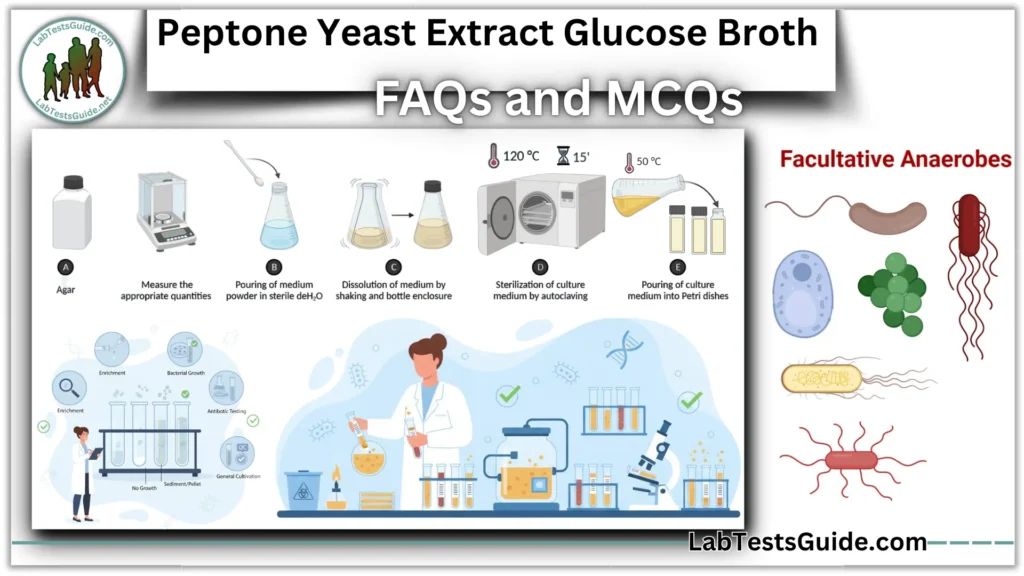
Peptone Yeast Extract Glucose Broth 50 FAQs
What is Peptone Yeast Extract Glucose (PYG) Broth?
It is an enriched, non-selective medium for cultivating fastidious anaerobic bacteria.
Who developed the original PYG Broth formulation?
The Virginia Polytechnic Institute (VPI) Anaerobe Laboratory.
What types of organisms are cultured using PYG Broth?
Fastidious anaerobes like Prevotella, Porphyromonas, and Bacteroides fragilis group.
Is PYG Broth selective or non-selective?
Non-selective but enriched for anaerobes.
What is the purpose of hemin and vitamin K in PYG Broth?
They are growth factors required by many fastidious anaerobes.
What are the main components of PYG Broth?
Pancreatic digest of casein, yeast extract, glucose, L-cysteine, hemin, and vitamin K.
Why is L-cysteine added to PYG Broth?
It acts as a reducing agent to maintain anaerobic conditions.
What is the role of glucose in PYG Broth?
It serves as an energy source for bacterial fermentation.
What is the final pH of PYG Broth?
pH 7.3 ± 0.5 at 25°C (varies slightly between formulations).
How is PYG Broth prepared to maintain anaerobiosis?
It is dispensed and sterilized under oxygen-free conditions (e.g., nitrogen/hydrogen atmosphere).
What is resazurin, and why is it used in some PYG Broth formulations?
A redox indicator that turns pink in the presence of oxygen, signaling contamination.
Can PYG Broth be autoclaved?
Yes, typically at 121°C for 15 minutes.
What is PYG Broth used for in clinical microbiology?
Cultivation and biochemical identification of anaerobic bacteria.
How is PYG Broth used in gas-liquid chromatography (GLC)?
It helps analyze short-chain fatty acid metabolites from glucose fermentation.
Can PYG Broth be used for microaerophilic bacteria?
Yes, for organisms like Campylobacter spp. when supplemented with formate-fumarate.
What are the supplemented versions of PYG Broth?
PYG with bile (20%), arginine, formate-fumarate, or Tween 80.
Why is bile added to PYG Broth?
To test bile resistance (e.g., Bacteroides fragilis grows, others are inhibited).
How does arginine supplementation help in identification?
It enhances growth of Eubacterium lentum.
Which organisms show enhanced growth with Tween 80?
Peptostreptococcus micros and some Bacteroides capillosus strains.
How should PYG Broth be inoculated?
With a young (6–72 hr) pure anaerobic culture via syringe through a rubber septum.
How is growth detected in PYG Broth?
Turbidity or sediment formation; pH changes indicate acid production.
What pH values indicate acid production in PYG Broth?
pH 5.5–6.0: weak acid; ≤5.5: strong acid; >6.0: no acid.
Why must PYG Broth be incubated anaerobically?
Oxygen inhibits strict anaerobes and may oxidize reducing agents.
How long should PYG Broth be incubated?
Typically 24–48 hours at 35–37°C.
What does a pink/purple color in PYG Broth indicate?
Oxygen exposure (resazurin oxidation); the medium should not be used.
Can PYG Broth alone identify anaerobic bacteria?
No, additional tests (biochemical, GLC, or molecular) are needed.
What are the limitations of PYG Broth?
Cannot differentiate species without supplemental tests.
How is PYG Broth quality control tested?
Using strains like Bacteroides fragilis (growth) and Clostridium perfringens (bile inhibition).
What should be done if growth occurs in broth but not on agar?
Subculture to check for contamination.
How should PYG Broth be stored?
At room temperature, protected from light, for up to 26 weeks.
What is PRAS medium?
Pre-reduced, anaerobically sterilized (e.g., PYG Broth).
How does PYG with formate-fumarate help in diagnostics?
Supports growth of Bacteroides ureolyticus-like organisms.
Which organisms are bile-resistant in PYG Broth?
Bacteroides fragilis group and some Fusobacterium spp.
What is the role of VPI salt solution in PYG Broth?
Provides pH-stabilizing phosphates and essential minerals.
What if PYG Broth shows no growth after incubation?
Check inoculum viability, anaerobic conditions, and medium expiration.
Can aerobic bacteria grow in PYG Broth?
No, unless contaminated (indicated by resazurin color change).
Why might PYG Broth give inconsistent results?
Improper storage, oxygen exposure, or expired medium.
Are there safety precautions for handling PYG Broth?
Treat as potentially infectious; use aseptic techniques.
Can PYG Broth components be harmful?
Animal-derived ingredients may carry pathogens; avoid skin contact.
How does PYG Broth differ from Thioglycollate Broth?
PYG is enriched for fastidious anaerobes; thioglycollate supports broader aerobes/anaerobes.
Is PYG Broth suitable for Clostridium species?
Yes, but bile inhibits Clostridium perfringens.
Can PYG Broth be used for pigment production studies?
Yes, hemin/vitamin K promote pigment in some species.
How does PYG Broth aid in bacterial identification via GLC?
Analyzes metabolic byproducts (e.g., acetic, propionic acids).
What is the shelf life of PYG Broth?
Up to 26 weeks when stored properly.
Can PYG Broth be frozen?
No, freezing may damage the medium.
Can PYG Broth be used for antibiotic susceptibility testing?
No, it is for culture and biochemical characterization.
What alternatives exist for PYG Broth?
Chopped Meat Broth or Schaedler Broth for anaerobes.
Is PYG Broth used in veterinary microbiology?
Yes, for isolating animal-derived anaerobes.
Can PYG Broth detect nitrate-reducing bacteria?
Yes, if supplemented with nitrate (not standard).
What is the significance of Sutterella wadsworthensis in PYG Broth?
Formerly Bacteroides gracilis, it requires formate-fumarate for growth.
Peptone Yeast Extract Glucose Broth 30 MCQs
- What is the primary purpose of Peptone Yeast Extract Glucose (PYG) Broth?
a) Selective isolation of aerobic bacteria
b) Cultivation and biochemical identification of obligate anaerobes✔
c) Detection of viral pathogens
d) Enrichment of fungal cultures - Which component in PYG Broth acts as a reducing agent to maintain anaerobic conditions?
a) Glucose
b) L-Cysteine✔
c) Sodium bicarbonate
d) Resazurin - What is the role of hemin and vitamin K in PYG Broth?
a) To inhibit gram-positive bacteria
b) To stimulate growth of fastidious anaerobes✔
c) To act as a pH indicator
d) To enhance oxygen diffusion - Which ingredient in PYG Broth serves as the primary energy source?
a) Yeast extract
b) Pancreatic digest of casein
c) Glucose✔
d) L-Cysteine - What is the final pH of PYG Broth?
a) 6.0 ± 0.5
b) 7.3 ± 0.5✔
c) 8.0 ± 0.5
d) 5.5 ± 0.5
- How is PYG Broth sterilized?
a) Filtration
b) Autoclaving at 121°C for 15 minutes✔
c) Boiling for 10 minutes
d) UV irradiation - What indicates a positive growth result in PYG Broth?
a) Color change to pink
b) Formation of gas bubbles
c) Turbidity with sediment✔
d) Solidification of the medium - A pH of ≤5.5 in PYG Broth after incubation indicates:
a) No acid production
b) Weak acid production
c) Strong acid production✔
d) Alkaline reaction - What does a purplish-pink color in PYG Broth indicate?
a) Presence of oxygen✔
b) Glucose fermentation
c) Contamination
d) Optimal anaerobic conditions - Which organism is expected to grow in PYG Broth with 20% bile?
a) Clostridium perfringens
b) Bacteroides fragilis✔
c) Eubacterium lentum
d) Prevotella melaninogenica
- PYG Broth is commonly used for:
a) Antibiotic susceptibility testing
b) Gas-liquid chromatography (GLC) analysis✔
c) Viral culture
d) Mycoplasma detection - Which group of organisms is inhibited by 20% bile in PYG Broth?
a) Bacteroides fragilis group
b) Most anaerobes except Bacteroides✔
c) Fusobacterium spp.
d) Eubacterium lentum - What supplement enhances the growth of Eubacterium lentum?
a) Arginine✔
b) Formate-fumarate
c) Tween 80
d) Bile - Which organism requires formate-fumarate for growth in PYG Broth?
a) Bacteroides ureolyticus✔
b) Peptostreptococcus micros
c) Clostridium perfringens
d) Prevotella melaninogenica - What is a limitation of PYG Broth?
a) It cannot support any bacterial growth
b) It provides complete identification without additional tests
c) Additional biochemical tests are needed for final identification✔
d) It only grows aerobic bacteria
- What is the shelf life of PYG Broth when stored properly?
a) 12 weeks
b) 26 weeks✔
c) 1 year
d) Indefinite - Which QC organism is used to validate PYG Broth performance?
a) Escherichia coli
b) Bacteroides fragilis ATCC 25285✔
c) Staphylococcus aureus
d) Pseudomonas aeruginosa - How should PYG Broth tubes be stored?
a) Frozen
b) Upright at room temperature, protected from light✔
c) Exposed to oxygen
d) In a refrigerator without caps - What indicates that PYG Broth is no longer usable?
a) Slight turbidity
b) Pink/purplish color (oxidized resazurin)✔
c) Yellow color
d) Presence of sediment - Which medium is recommended for subculturing PYG Broth isolates?
a) MacConkey Agar
b) AnaeroGRO™ Brucella Agar with H and K✔
c) Blood Agar (aerobic)
d) Sabouraud Dextrose Agar
- PYG Broth was originally formulated by:
a) CDC
b) Virginia Polytechnic Institute (VPI)✔
c) Hardy Diagnostics
d) ATCC - Resazurin in PYG Broth acts as a(n):
a) Nutrient
b) Oxygen indicator✔
c) Antibiotic
d) Buffer - Which organism shows enhanced growth with Tween 80?
a) Bacteroides fragilis
b) Peptostreptococcus micros✔
c) Eubacterium lentum
d) Clostridium perfringens - PYG Broth is prepared under which gas atmosphere?
a) Oxygen and CO₂
b) Nitrogen and hydrogen✔
c) Methane
d) Air - What is the purpose of VPI salt solution in PYG Broth?
a) To inhibit contaminants
b) To stabilize pH and provide essential ions✔
c) To enhance pigment production
d) To act as a carbon source
- Which technique is used to analyze metabolic products from PYG Broth?
a) PCR
b) Gas-liquid chromatography (GLC)✔
c) ELISA
d) Gram staining - PYG Broth is NOT suitable for:
a) Culturing Prevotella spp.
b) Identifying aerobic bacteria✔
c) Detecting short-chain fatty acids
d) Growing Porphyromonas spp. - What should be done if an isolate grows in PYG Broth but not on solid media?
a) Discard the culture
b) Subculture to check for contamination✔
c) Report as sterile
d) Incubate longer aerobically - Which of the following is NOT a fastidious anaerobe grown in PYG Broth?
a) Bacteroides fragilis
b) Prevotella melaninogenica
c) Escherichia coli✔
d) Porphyromonas spp. - What is the recommended incubation temperature for PYG Broth?
a) 25°C
b) 30°C
c) 35-37°C✔
d) 42°C
